
About
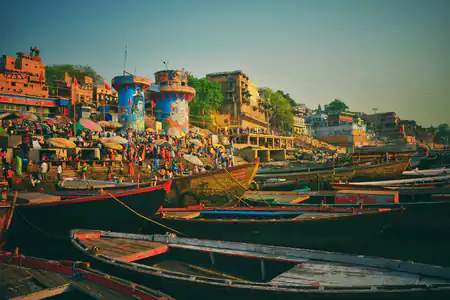
Varanasi is not a city that can be explained — it must be experienced, and even then it resists comprehension. Known to the ancients as Kashi, the "City of Light," this settlement on the western bank of the Ganges is among the oldest continuously inhabited cities on Earth, with evidence of habitation stretching back over 3,000 years. Mark Twain, visiting in 1897, wrote that Varanasi is "older than history, older than tradition, older even than legend, and looks twice as old as all of them put together." It is the holiest city in Hinduism, one of the most sacred in Buddhism and Jainism, and a place where the boundary between the living and the dead, the mundane and the divine, dissolves into the smoke that rises perpetually from its cremation ghats. The city's sacred geography is defined by 84 ghats — broad stone staircases descending into the Ganges — that stretch along nearly seven kilometers of the river's western bank. Each ghat carries its own mythology, its own rituals, its own accumulated centuries of human devotion. At Dashashwamedh Ghat, the principal ghat, the spectacular Ganga Aarti ceremony unfolds each evening at sunset: Brahmin priests perform an elaborate choreography of fire, incense, and chanting before thousands of devotees and visitors, the flames of massive brass lamps reflecting off the dark waters of the Ganges in a spectacle that has been performed without interruption for centuries. At Assi Ghat, pilgrims begin their day with ritual bathing at the confluence of the Assi River and the Ganges. At Manikarnika Ghat — the most sacred cremation ground in all of Hinduism — funeral pyres burn day and night, and have burned without interruption for thousands of years. The Dom Raja, hereditary keeper of the sacred flame, maintains the eternal fire from which all cremation pyres are lit. Hindu theology holds that Varanasi exists outside the normal cycle of creation and destruction — when the universe is dissolved at the end of each cosmic age, Varanasi is lifted on Lord Shiva's trident and preserved above the waters of annihilation, then set down again when the world is recreated. To die in Varanasi is to achieve moksha — liberation from the cycle of death and rebirth (samsara) — bypassing the need for further incarnations. This belief draws the elderly and the terminally ill from across India to spend their final days in special hospices (mukti bhavans) along the ghats, waiting for death as a liberation rather than an ending. The cremation fires at Manikarnika Ghat consume approximately 200-300 bodies each day, their ashes scattered into the Ganges, and the families of the dead consider this not a scene of sorrow but of ultimate spiritual release. Varanasi's significance extends far beyond Hinduism. Just ten kilometers northeast, at Sarnath, the Buddha delivered his first sermon — the Dhammacakkappavattana Sutta, "Setting the Wheel of Dharma in Motion" — around 528 BCE, founding the Buddhist religion in the deer park where Emperor Ashoka later erected one of his great pillars. The Jain tradition holds that four of the twenty-four Tirthankaras were born in Varanasi. The city has been a center of learning, philosophy, music, and poetry for millennia — the great Sanskrit grammarian Panini, the philosopher-saint Kabir, the poet Tulsidas, and the sitar master Ravi Shankar all called Varanasi home. Silk weaving, particularly the famous Banarasi sari with its gold and silver brocade, has been practiced here for centuries. To walk through Varanasi is to walk through every layer of Indian civilization simultaneously — ancient and modern, sacred and profane, life and death existing in a single, overwhelming, unforgettable embrace.
Historical Significance
“Varanasi occupies a position in Hindu civilization comparable to Jerusalem in the Abrahamic traditions — it is the axis mundi, the point where heaven touches earth, the city that Shiva himself chose as his earthly abode. According to the Kashi Khanda section of the Skanda Purana, one of the most important Hindu texts, Varanasi was founded by Shiva at the dawn of creation and is the one place on earth that is never abandoned by the gods. The city's name derives from its location between two tributaries of the Ganges — the Varuna to the north and the Asi (Assi) to the south — though the ancient name Kashi, meaning "luminous" or "city of light," reflects its spiritual rather than geographical identity. The Kashi Vishwanath Temple, dedicated to Shiva as Lord of the Universe, has been destroyed and rebuilt multiple times throughout history — most recently in the 17th century after Mughal emperor Aurangzeb demolished the previous temple and built the Gyanvapi Mosque partly on its foundations, a historical wound that remains politically sensitive to this day. Varanasi's role as a center of learning and philosophy shaped the intellectual history of the Indian subcontinent. The city was already a renowned seat of scholarship when the Buddha arrived around 528 BCE, choosing nearby Sarnath for his first teaching precisely because Varanasi's reputation would attract serious seekers. The Buddhist ruins at Sarnath — including the Dhamek Stupa marking the exact spot of the first sermon and the Ashoka Pillar with its four-lion capital (now India's national emblem) — testify to the city's importance in the spread of Buddhism across Asia. In the medieval period, Varanasi became a crucible for the Bhakti movement, which sought to make spiritual liberation accessible to all castes and classes. The weaver-poet Kabir (c. 1440-1518), who lived and taught in Varanasi, synthesized Hindu and Muslim mysticism into a radical philosophy of direct spiritual experience that rejected all organized religion — his followers still maintain a presence in the city. The living heritage of Varanasi is perhaps its most extraordinary dimension. Unlike archaeological sites frozen in a particular historical moment, Varanasi is a sacred city that has been in continuous, unbroken ritual use for over three millennia. The cremation fires at Manikarnika Ghat are said never to have been extinguished — a claim that, while impossible to verify, reflects a continuity of practice that is genuinely ancient. The Ganga Aarti ceremony performed nightly at Dashashwamedh Ghat, the silk-weaving traditions of the Muslim and Hindu weavers in the old city, the classical music traditions nurtured in the city's gharanas (musical lineages), and the philosophical debates that still take place in the Sanskrit colleges along the ghats all represent living continuations of traditions that stretch back centuries or millennia. Varanasi does not preserve the past — it inhabits it.”
Historias
3History
👑 Built by
Lord Shiva (mythological founder); historical founding pre-dates recorded history
~1200 BCE - Traditional date for the founding of Kashi; archaeological evidence confirms habitation in this period
~800 BCE - Varanasi emerges as a major center of Vedic learning and philosophy; the Kashi kingdom is mentioned in Vedic literature
~528 BCE - Siddhartha Gautama (the Buddha) delivers his first sermon at Sarnath, 10 km from Varanasi, founding Buddhism
~300 BCE - Emperor Ashoka erects pillars and stupas at Sarnath; the four-lion capital becomes India's national emblem millennia later
~500 CE - Varanasi flourishes as a center of Hindu learning; Chinese pilgrim Xuanzang describes thousands of temples and scholars
1194 - Qutb ud-Din Aibak's forces sack Varanasi; many temples destroyed, beginning centuries of intermittent destruction and rebuilding
~1440-1518 - The weaver-poet Kabir lives and teaches in Varanasi, synthesizing Hindu and Muslim mysticism
1585 - Mughal Emperor Akbar visits Varanasi and commissions the construction of two temples, ushering in a period of relative tolerance
1669 - Mughal Emperor Aurangzeb orders the destruction of the Kashi Vishwanath Temple and builds the Gyanvapi Mosque on part of its site
1780 - Ahilyabai Holkar of Indore rebuilds the Kashi Vishwanath Temple adjacent to the Gyanvapi Mosque
1835 - Maharaja Ranjit Singh donates 1,000 kg of gold to plate the temple's spire, giving it the name 'Golden Temple of Varanasi'
1897 - Mark Twain visits Varanasi and writes his famous description: 'older than history, older than tradition, older even than legend'
2021 - Kashi Vishwanath Corridor inaugurated, connecting the temple directly to the ghats through a restored historic pathway