
About
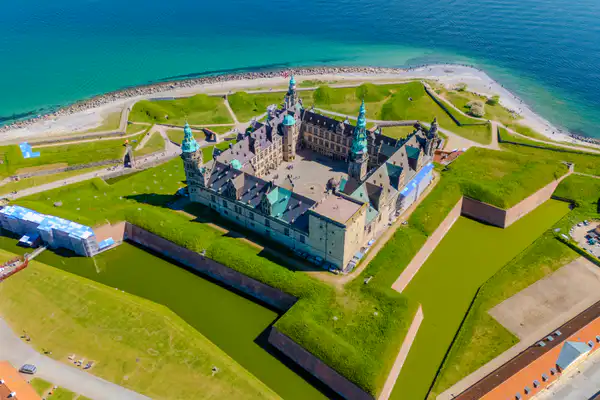
Kronborg Castle stands at the narrowest point of the Øresund, the strait separating Denmark from Sweden, where barely four kilometers of water divide two nations and two worlds. For over four centuries, every ship entering or leaving the Baltic Sea had to pass within cannon range of this fortress, and for most of that time, every captain had to lower his flag, heave to, and pay a toll to the Danish crown. This single geographic fact made Kronborg one of the most strategically important — and financially lucrative — castles in all of Europe, and it made Denmark one of the wealthiest kingdoms in the world. The castle visitors see today is primarily the creation of King Frederick II, who between 1574 and 1585 transformed a modest medieval fortress called Krogen into one of the grandest Renaissance castles in northern Europe. Frederick imported Flemish architects and craftsmen, sheathed the exterior in Gotland sandstone that gleams pale gold in the Scandinavian light, and created interiors of such magnificence that visiting ambassadors wrote home in astonishment. The Great Hall, at sixty-two meters long, was the largest banqueting hall in northern Europe, its walls hung with forty tapestries depicting the kings of Denmark from the mythical founder Dan to Frederick himself — a dynastic statement woven in silk and gold thread. But Kronborg's fame rests on something far beyond its architecture or its strategic position. In 1601, William Shakespeare set his most celebrated tragedy at this castle, which he called Elsinore — an anglicization of Helsingør, the town that surrounds the fortress. The Tragedy of Hamlet, Prince of Denmark transformed Kronborg from a military installation into a literary monument, the most famous castle in world literature. Shakespeare almost certainly never visited Kronborg, but English actors had performed at the castle in 1585, and their descriptions of the fortress, the strait, and the cold northern winds that howl across the battlements are woven into the fabric of the play. When Hamlet stands on the battlements and encounters his father's ghost, when he delivers the most famous soliloquy in the English language, when the final bloody catastrophe unfolds in the great hall, he does so in a place that is both real and imagined, historical and eternal. Beneath the castle, in the dark casemates that wind through the fortress foundations, sits a statue of another legendary figure: Holger Danske, the sleeping warrior of Danish mythology, who according to legend will awaken when Denmark faces its greatest peril. During the German occupation of World War II, the Danish resistance movement adopted Holger Danske as their name and symbol, transforming the sleeping knight into a living force of national defiance. Kronborg was designated a UNESCO World Heritage Site in 2000, recognized as an outstanding example of Renaissance military architecture and as the setting of one of the most important works in the history of Western literature. It remains an active cultural venue, hosting annual Shakespeare performances on the castle grounds that draw audiences from around the world to hear Hamlet's words spoken in the very place where Shakespeare imagined them.
Historical Significance
“...s transformation from a utilitarian medieval fortress into a Renaissance masterpiece reflected Denmark's ambition to project cultural sophistication alongside military power. Kronborg's significance was multiplied immeasurably when Shakespeare chose it as the setting for Hamlet around 1600. The play elevated the castle from a regional fortification to a universal symbol — a stage upon which the fundamental questions of human existence are enacted. The ghost on the battlements, the prince torn between action and contemplation, the corruption festering behind magnificent walls: these images have been inseparable from Kronborg for over four centuries. UNESCO inscribed Kronborg on the World Heritage List in 2000, recognizing both its outstanding architectural and historical significance and its unique place in world literature. The inscription noted that Kronborg is "the pre-eminent example of the Renaissance fortified castle in northern Europe" and acknowledged its "immense symbolic value for the Danish people and its world-wide fame through Hamlet."”
داستانها
2History
👑 Built by
King Frederick II of Denmark (rebuilt from medieval fortress Krogen)
1420s - King Eric of Pomerania builds the original fortress Krogen to control the Øresund and collect the Sound Toll
1429 - The Sound Toll (Oresundstolden) is officially established; every ship passing through the strait must pay
1574-1585 - King Frederick II transforms Krogen into Renaissance castle Kronborg with Flemish architects
1585 - English actors perform at Kronborg — likely providing Shakespeare with details for Hamlet
1601 - Shakespeare's Hamlet is first performed, setting the world's most famous play at "Elsinore"
1629 - Devastating fire destroys much of Kronborg's interior; only the chapel survives intact
1631-1639 - King Christian IV rebuilds Kronborg, adding the current Baroque-influenced interiors
1658-1660 - Swedish forces capture Kronborg during the Swedish Wars; castle besieged and occupied
1785 - Castle converted to military barracks; Sound Toll continues to fund Danish military
1857 - Sound Toll abolished under international pressure; 35 nations pay Denmark compensation
1915 - Castle ceases to be a military installation; restoration and opening to the public begins
2000 - Inscribed as a UNESCO World Heritage Site