
About
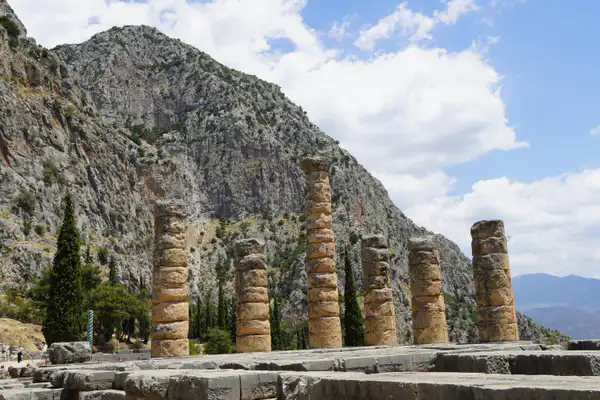
Delphi was the most sacred site in the ancient Greek world — the place where heaven touched earth, where mortals could hear the voice of the gods. For over a thousand years, kings, generals, and ordinary people journeyed from across the Mediterranean to consult the Oracle, whose cryptic prophecies shaped the course of history. The Greeks believed Delphi was the exact center of the world — the Omphalos, the Navel of the Earth. According to myth, Zeus released two eagles from the ends of the earth, and they met at Delphi, marking it as the world's midpoint. The sacred Omphalos stone, carved with a net-like pattern, still marks this cosmic center. The Oracle of Delphi — the Pythia — was a priestess who entered a trance state and delivered prophecies from Apollo himself. She sat upon a tripod over a chasm in the earth, breathing vapors that rose from below, speaking in riddles that priests interpreted for suppliants. Her prophecies were often ambiguous, but they were always taken seriously: no Greek colony was founded, no war was declared, no major decision was made without consulting the Oracle first. The sanctuary complex grew over centuries to include the Temple of Apollo (rebuilt seven times), the sacred theater (seating 5,000), the stadium (where the Pythian Games were held), and treasuries built by Greek city-states to house their offerings. The Sacred Way wound up the hillside, lined with monuments and statues — a processional route that pilgrims followed to reach the temple. The famous inscriptions at Delphi — "Know Thyself" (Γνῶθι Σεαυτόν) and "Nothing in Excess" (Μηδὲν Ἄγαν) — became the foundation of Greek philosophy. Socrates said that "Know Thyself" was the beginning of all wisdom. These maxims, carved at the entrance to Apollo's temple, have echoed through Western thought for 2,500 years. The Oracle's influence was immense. She told Croesus of Lydia that if he attacked Persia, a great empire would fall (it was his own). She told the Athenians to trust in their "wooden walls" (the fleet that won at Salamis). She told Oedipus that he would kill his father and marry his mother. For over a thousand years, the future of the ancient world was revealed — and concealed — in the rocky sanctuary above the Pleistos gorge.
Historical Significance
“Delphi was more than a religious site — it was the diplomatic and spiritual center of the Greek world. The concept of Greek unity, despite the city-states' constant warfare, was embodied at Delphi through the Amphictyonic League, a religious association that protected the sanctuary and organized the Pythian Games. The Oracle's influence extended far beyond Greece. Croesus of Lydia, the richest man in the world, sent gifts of gold. The Pharaohs of Egypt consulted her. Roman emperors sought her wisdom. Alexander the Great visited before his conquest of the known world. The Oracle's responses shaped the founding of colonies from Marseilles to Cyrene, the outcomes of wars, and the fates of dynasties. The priestess who served as Pythia was originally a young virgin, but after one was seduced by a supplicant, the role was given to women over fifty who dressed as maidens. She served for life, entering a trance state through unknown means — ancient sources mention vapors rising from a chasm, chewing laurel leaves, and drinking from the sacred Castalian Spring. The Oracle's decline began when Christianity rose and Roman emperors converted. In 390 CE, Emperor Theodosius I closed the sanctuary as part of his campaign against paganism. The final Oracle, when asked about the god's plans, reportedly said: "Tell the king the fair-wrought hall has fallen. Apollo no longer has a shelter, nor a prophetic laurel, nor a speaking spring. The water of speech is quenched." The archaeological site was excavated primarily by the French School at Athens beginning in 1892. They uncovered the Temple of Apollo, the Theater, the Stadium, the Treasury buildings, and thousands of artifacts including the famous Bronze Charioteer. Today, Delphi is a UNESCO World Heritage Site, drawing visitors who still seek to touch the place where ancient Greeks heard the voice of the divine.”
داستانها
7History
👑 Built by
Various Greek city-states and rulers over 1,000+ years
~1400 BCE - Earliest worship at the site, possibly to Earth goddess Gaia
~1100 BCE - Mycenaean collapse; worship continues
8th century BCE - Apollo cult established; Oracle begins prophesying
7th century BCE - First stone Temple of Apollo constructed
586 BCE - First Pythian Games held (one of four Panhellenic Games)
548 BCE - Temple of Apollo burns; rebuilt with contributions from all Greece
480 BCE - Oracle advises Athens to trust "wooden walls" before Salamis
373 BCE - Earthquake destroys temple; rebuilt by 330 BCE
356 BCE - Philip II of Macedon gains control after Third Sacred War
279 BCE - Gallic invasion repelled (attributed to Apollo's intervention)
191 BCE - Romans defeat Seleucid forces near Delphi
86 BCE - Sulla plunders Delphi's treasures
67 CE - Nero removes 500 bronze statues
390 CE - Oracle silenced by Emperor Theodosius I
1892 - French excavations begin
1987 - UNESCO World Heritage Site designation