
About
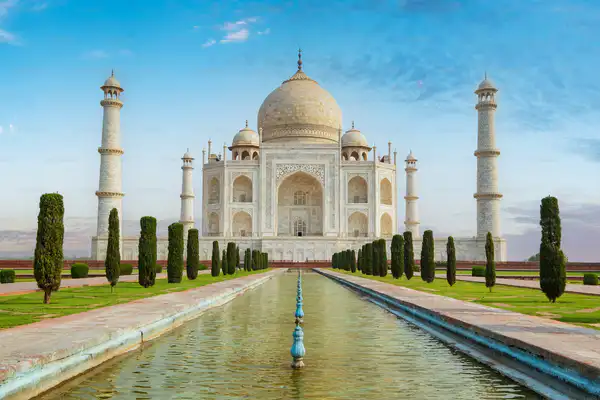
The Taj Mahal rises from the banks of the Yamuna River in Agra like a vision suspended between earth and heaven — a mausoleum so perfect in its proportions, so luminous in its white Makrana marble, that it has become the universal symbol of eternal love. Commissioned in 1632 by the Mughal Emperor Shah Jahan to enshrine the memory of his beloved wife Mumtaz Mahal, who died giving birth to their fourteenth child during a military campaign in Burhanpur, the Taj Mahal is not merely a tomb but a crystallized expression of inconsolable grief transformed into architectural perfection. Standing 73 meters tall at the apex of its central dome, the monument commands its gardens, its reflecting pools, and its river setting with a serenity that has silenced visitors for nearly four centuries. The construction consumed 22 years (1632-1653) and the labor of over 20,000 workers — masons, stonecutters, inlayers, calligraphers, dome-builders, and artisans drawn from across the Mughal Empire and beyond. The chief architect is widely believed to have been Ustad Ahmad Lahauri, though the project was a collaboration of master craftsmen from Persia, the Ottoman Empire, and Central Asia. Over 1,000 elephants transported materials from across India and Asia: translucent white marble from the quarries of Makrana in Rajasthan, jasper from Punjab, jade and crystal from China, turquoise from Tibet, lapis lazuli from Afghanistan, sapphires from Sri Lanka, and carnelian from Arabia. The pietra dura inlay work — flowers, vines, and geometric patterns set into the marble using precisely cut semi-precious stones — is so refined that a single three-centimeter flower can contain sixty or more individual stone pieces, their joints invisible to the naked eye. The architectural genius of the Taj Mahal lies in its calculated illusions and perfect symmetry. The four minarets, each standing 40 meters tall, lean imperceptibly outward — approximately two degrees from vertical — so that in the event of an earthquake, they would fall away from the central tomb rather than onto it. This tilt also creates an optical illusion: when viewed from below, the minarets appear perfectly vertical, and when viewed from a distance, they seem to lean inward, making the dome appear to float. The calligraphy inscribed around the great arched portals (pishtaqs) grows progressively larger as it rises, so that from ground level every letter appears the same size — a masterful correction of visual perspective attributed to the calligrapher Amanat Khan. The entire complex is organized around perfect bilateral symmetry, with one famous exception: Shah Jahan's own cenotaph, placed beside Mumtaz Mahal's in the crypt, which breaks the central axis — the only asymmetrical element in the entire monument, poignantly suggesting that even in death, the emperor would not be parted from his queen. The Taj Mahal shifts character with every change of light — blushing pink at dawn, blazing white under the midday sun, glowing amber at sunset, and turning an ethereal blue-silver under moonlight. This chameleonic quality, produced by the translucency of the Makrana marble, gives the monument an almost living presence. Shah Jahan himself was imprisoned by his son Aurangzeb in 1658 in the nearby Agra Fort, where he spent his final eight years gazing across the Yamuna at the tomb he had built for his wife. According to court chronicles, a mirror was placed in his chamber so that even when too frail to sit upright, the aging emperor could see the Taj Mahal reflected from his bed. When Shah Jahan died in 1666, he was buried beside Mumtaz Mahal — reunited in the monument that had been his grief, his obsession, and his masterpiece.
Historical Significance
“The Taj Mahal stands as the supreme achievement of Mughal architecture and is universally regarded as one of the most beautiful buildings ever constructed by human hands. It represents the zenith of a syncretic Indo-Islamic architectural tradition that fused Persian, Ottoman, Indian, and Central Asian design elements into something entirely new. The monument draws on the Paradise Garden (Char Bagh) tradition of Timurid Persia, the double-dome technology of Central Asia, the pietra dura inlay techniques of Florentine Italy (introduced to the Mughal court), and the white marble craftsmanship perfected in Rajasthan. The result is a building that transcends any single cultural tradition — a truly universal masterwork. The story behind the Taj Mahal is inseparable from its significance. Shah Jahan and Mumtaz Mahal (born Arjumand Banu Begum) were married in 1612 and, by all historical accounts, shared an extraordinarily close relationship unusual among royal marriages of the era. Mumtaz was Shah Jahan's constant companion, even accompanying him on military campaigns. Her death on June 17, 1631, while giving birth to their fourteenth child, Gauhara Begum, reportedly left Shah Jahan so devastated that his hair turned white within months and he withdrew from public life. The Taj Mahal was his response to that loss — a promise reportedly made to Mumtaz on her deathbed to build a monument the world had never seen. The persistent legend that Shah Jahan planned a matching "Black Taj Mahal" on the opposite bank of the Yamuna, connected by a bridge, has no solid historical foundation but reflects the romantic mythology that has enveloped the monument. What is historically documented are dark foundations and remnants of a garden complex (the Mehtab Bagh or "Moonlight Garden") on the opposite bank, which served as a viewing platform for the Taj. The Taj Mahal was inscribed as a UNESCO World Heritage Site in 1983 and was selected as one of the New Seven Wonders of the World in 2007. It draws 7-8 million visitors annually, making it India's most iconic landmark and one of the most photographed structures on Earth. Its influence on architecture has been immense, inspiring buildings from the Victoria Memorial in Kolkata to the Sultan Omar Ali Saifuddien Mosque in Brunei. The Indian government has undertaken extensive conservation efforts to combat the yellowing of the marble caused by air pollution, including establishing a 10,400-square-kilometer Taj Trapezium Zone around the monument to regulate industrial emissions.”
Récits
3History
👑 Built by
Emperor Shah Jahan (chief architect: Ustad Ahmad Lahauri)
1612 - Shah Jahan (then Prince Khurram) marries Arjumand Banu Begum, who receives the title Mumtaz Mahal ("Jewel of the Palace")
June 17, 1631 - Mumtaz Mahal dies in Burhanpur giving birth to their fourteenth child, Gauhara Begum
1632 - Construction of the Taj Mahal begins on the south bank of the Yamuna River in Agra
1637 - The main mausoleum structure is largely completed; interior decoration and garden work continue
1643 - The central dome and the four minarets are completed
1648 - The surrounding buildings — mosque, guest house (jawab), and main gateway (darwaza) — are completed
1653 - The entire Taj Mahal complex is officially completed after 22 years of construction
1658 - Aurangzeb deposes Shah Jahan and imprisons him in Agra Fort, where the emperor can see the Taj Mahal from his quarters
January 22, 1666 - Shah Jahan dies in Agra Fort and is buried beside Mumtaz Mahal in the Taj Mahal
1857 - British soldiers and officials deface the Taj Mahal during the Indian Rebellion, prying precious stones from its walls
1908 - Lord Curzon commissions a major restoration, replacing the stolen inlay stones and donating the bronze lamp in the interior chamber
1942 - During World War II, scaffolding erected around the dome to disguise the Taj Mahal from Japanese and German bombers
1983 - Designated a UNESCO World Heritage Site
1996 - Indian Supreme Court orders closure of polluting industries in the Taj Trapezium Zone to protect the marble
2007 - Selected as one of the New Seven Wonders of the World