
About
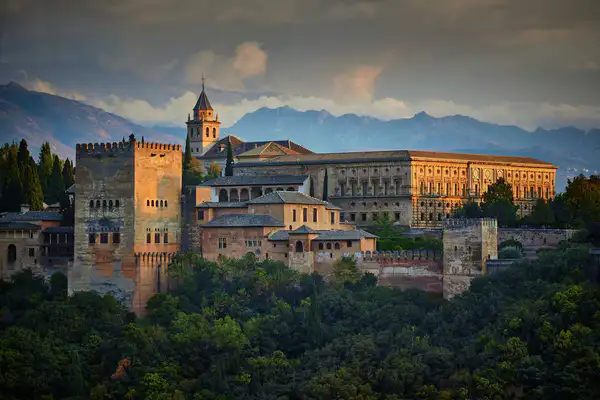
The Alhambra — "The Red One," from the Arabic Al-Qal'a al-Hamra (القلعة الحمراء) — rises above Granada like a vision from a poet's dream, its reddish walls crowning the Sabika hill against the snow-capped peaks of the Sierra Nevada. It is the most complete surviving palace of the Islamic world, the supreme masterpiece of Moorish architecture in Europe, and one of the most visited monuments on Earth. But it is more than a building. The Alhambra is the last breath of Al-Andalus — the final, exquisite flowering of a civilization that ruled Iberia for nearly eight centuries before vanishing in a single afternoon of tears. The fortress-palace complex began as a modest 9th-century alcazaba (citadel) perched on the hill overlooking Granada. It was the Nasrid dynasty — the last Muslim dynasty in Spain — that transformed it into a paradise on earth. Muhammad I ibn al-Ahmar, who established the Nasrid Emirate in 1238 after the great Almohad collapse, chose the Sabika hill as his seat of power and began the monumental construction. His successors, particularly Yusuf I (r. 1333-1354) and his son Muhammad V (r. 1354-1359, 1362-1391), elevated the complex into one of the wonders of the medieval world. In an age when Christian Europe was building massive stone cathedrals designed to overpower the senses with sheer mass, the Nasrid architects chose the opposite path: lightness, intricacy, water, and light. The Nasrid Palaces are the heart of the Alhambra and among the most refined spaces ever created by human hands. The Court of the Myrtles (Patio de los Arrayanes) uses a long reflecting pool flanked by myrtle hedges to mirror the architecture, doubling the beauty and creating a sense of infinite depth. The Court of the Lions (Patio de los Leones), the most famous courtyard in Islamic architecture, is surrounded by 124 slender marble columns supporting muqarnas arches of astonishing complexity, with twelve marble lions supporting a central fountain. Every surface is alive — the walls encrusted with stucco arabesques so intricate they resemble frozen lace, calligraphic inscriptions praising God and the sultan winding through the decoration like rivers of meaning, and geometric tile work (zellij) covering the lower walls in mathematical patterns that approach infinity. Water is the Alhambra's secret genius. In a semi-arid landscape, the Nasrid engineers channeled water from the Darro River through a six-kilometer canal (the Acequia Real) to feed hundreds of fountains, channels, basins, and cascades throughout the complex. Water appears everywhere — running through narrow channels carved into marble floors, bubbling from fountain basins, sheeting down tilted surfaces, collecting in still pools that mirror the architecture above. The sound of water is the Alhambra's constant companion, cooling the air, delighting the ear, and fulfilling the Quranic vision of paradise as a garden with flowing streams. The Generalife (Jannat al-Arif, "Garden of the Architect" or "Garden of the Lofty Paradise"), the sultans' summer estate on the hillside above the Alhambra, extends this water paradise into landscaped terraces. The Patio de la Acequia, with its famous arching water jets, is perhaps the most romantic garden space in Europe — a place where Nasrid sultans retreated from the affairs of state to listen to water and contemplate eternity. But history is not romantic. On January 2, 1492, the last Nasrid sultan, Muhammad XII — known to the Spanish as Boabdil — surrendered the keys of the Alhambra to Ferdinand and Isabella, ending 781 years of Muslim rule in Iberia. As Boabdil rode away from Granada along the mountain pass now called the Puerto del Suspiro del Moro (Pass of the Moor's Sigh), he turned for a final look at his lost kingdom and wept. His mother, Aixa, is said to have delivered one of history's most devastating rebukes: "You weep like a woman for what you could not hold as a man." Whether or not the words were actually spoken, they have echoed through five centuries as the epitaph of Al-Andalus. The Catholic monarchs initially respected the Alhambra, living within its walls and marveling at its beauty. But their grandson Charles V (Carlos V) committed what many consider an act of cultural violence: in 1527, he ordered the construction of a massive Renaissance palace in the very heart of the Alhambra complex, demolishing a section of the Nasrid palace to make room. The circular interior courtyard of the Palace of Carlos V, while architecturally impressive in its own right, sits beside the Nasrid palaces like a boulder dropped into a garden of silk. The Alhambra fell into neglect over the following centuries, used as a barracks, a prison, and even a stable. Napoleon's troops occupied it in 1812 and attempted to blow it up on their retreat — only the quick action of a Spanish soldier who cut the fuse saved the complex from annihilation. By the early 19th century, squatters, beggars, and thieves inhabited its crumbling rooms. It was an American writer, Washington Irving, who rescued the Alhambra from obscurity. In 1829, Irving lived in the palace for several months, gathering the legends and ghost stories of its inhabitants, and published "Tales of the Alhambra" in 1832 — a book that became an international sensation and sparked a wave of Romantic tourism that ultimately led to the palace's restoration and preservation. Today the Alhambra receives nearly three million visitors annually, and tickets must be booked weeks in advance. It remains what it was always meant to be: a meditation on paradise, beauty, and the transience of earthly power, inscribed on its own walls in the endlessly repeated phrase "Wa la ghalib illa Allah" — There is no victor but God.
Historical Significance
“The Alhambra is the single most important surviving monument of Islamic civilization in Western Europe and the crowning achievement of the Nasrid dynasty, the last Muslim rulers of the Iberian Peninsula. Its significance operates on multiple levels — artistic, architectural, hydraulic, literary, and political — each profound enough to justify its fame independently. Architecturally, the Alhambra represents the apex of Islamic decorative art. The Nasrid artisans achieved a level of ornamental complexity that has never been surpassed. The muqarnas (honeycomb vaulting) of the Hall of the Two Sisters contains over 5,000 individual cells, creating the illusion of a crystalline cave dissolving into infinity — a deliberate representation of the rotating dome of heaven. The stucco work, carved by hand into wet plaster, incorporates three interlocking systems of decoration — calligraphy, vegetal arabesque, and geometric pattern — that cover every surface and embody the Islamic artistic principle that empty space is an invitation to fill with praise of God. The zellij tilework on the lower walls uses only a handful of geometric shapes to generate patterns of bewildering complexity, patterns that mathematicians have shown contain examples of quasicrystalline geometry — mathematical structures not formally described by Western science until Roger Penrose's work in the 1970s. The hydraulic engineering of the Alhambra was centuries ahead of contemporary European technology. The Nasrid engineers created a pressurized water system using gravity and the natural slope of the terrain, channeling water from the Darro River through the Acequia Real (Royal Canal) to supply the entire complex. The fountains in the Court of the Lions originally operated without any mechanical pumps — the water pressure was generated solely by the height differential between the canal intake and the courtyard, a feat of engineering that European hydraulics would not match until the Renaissance. Politically, the Alhambra's surrender in 1492 marks one of the most consequential dates in world history. The fall of Granada completed the Reconquista, the 781-year Christian reconquest of Iberia, and freed Ferdinand and Isabella to fund Columbus's voyage later that same year. The expulsion of Muslims and Jews that followed transformed Spain and reshaped the Mediterranean world. The Alhambra thus stands at the hinge point between the medieval and modern worlds. Literarily, Washington Irving's "Tales of the Alhambra" (1832) created the template for Romantic travel writing and almost single-handedly saved the monument from destruction. Irving's tales of enchanted Moorish princesses, hidden treasures, and ghostly sultans transformed the crumbling ruin into the most romantic building in Europe and launched the tourism industry that continues today. The Alhambra became the primary inspiration for the Moorish Revival architectural movement that produced buildings across Europe and America. The Court of the Lions remains one of the most analyzed and debated architectural spaces in art history. The twelve marble lions supporting the central fountain have been interpreted as representing the twelve tribes of Israel (reflecting the Nasrid court's close ties with Jewish scholars and advisors), the twelve signs of the zodiac, or the twelve months of the year. A 14th-century poem by Ibn Zamrak, carved into the fountain basin itself, describes the lions as fierce warriors guarding the sultan's justice. The court's perfect proportions and the mathematical relationships between its columns and arches have generated centuries of scholarly analysis, much of it confirming that the Nasrid architects achieved a mathematical sophistication that rivals the classical Greek tradition.”
物語
2History
👑 Built by
Nasrid Dynasty: Muhammad I ibn al-Ahmar (founded 1238); Yusuf I and Muhammad V (masterpiece phase, 1333-1391)
889 CE - First fortification built on the Sabika hill by Sawwar ben Hamdun during civil conflicts of the Emirate of Cordoba
1013 CE - Zirid dynasty expands the fortress as the Caliphate of Cordoba collapses
1238 - Muhammad I ibn al-Ahmar establishes Nasrid Emirate and begins transforming the Alhambra into a royal residence
1273 - Muhammad II completes the Alcazaba (military fortress) and begins the palace complex
1333-1354 - Yusuf I builds the Comares Palace, Tower of Comares, and the Court of the Myrtles
1354-1391 - Muhammad V builds the Court of the Lions, Hall of the Abencerrajes, and Hall of the Two Sisters — the artistic peak
1492 - January 2: Boabdil surrenders the Alhambra to Ferdinand and Isabella; end of Muslim rule in Iberia
1492 - The Alhambra Decree expels Jews from Spain; Columbus receives funding for his voyage
1527 - Carlos V orders construction of a Renaissance palace within the Alhambra complex, partially demolishing Nasrid structures
1812 - Napoleon's retreating troops attempt to blow up the Alhambra; a Spanish soldier cuts the fuses, saving most of the complex
1829 - Washington Irving lives in the Alhambra and gathers material for "Tales of the Alhambra"
1832 - Irving publishes "Tales of the Alhambra," sparking international interest and Romantic tourism
1870 - Alhambra declared a national monument of Spain; systematic restoration begins
1984 - UNESCO inscribes the Alhambra, Generalife, and Albayzin as a World Heritage Site