
About
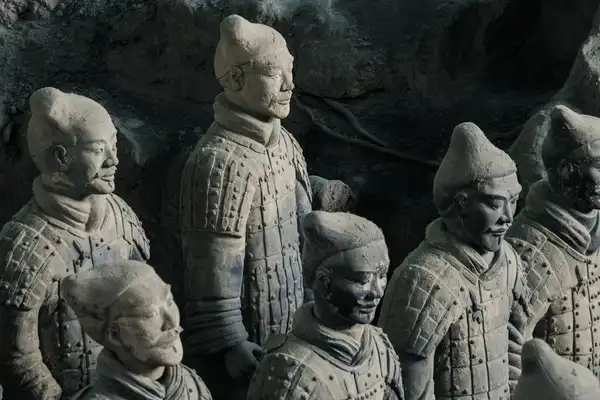
s First Emperor, Qin Shi Huang. Discovered accidentally in 1974 by farmers digging a well near Xi'an, the warriors were arranged in battle formation in three vast underground pits. Each figure is unique — individually sculpted faces, hairstyles, expressions, and body types representing every rank from generals to foot soldiers, archers to cavalrymen. No two are alike among the thousands. The warriors are merely the outer guard of something far more ambitious: the tomb of Qin Shi Huang himself. According to the historian Sima Qian, writing just a century after the emperor's death, the tomb contains a miniature replica of the entire empire, with rivers and seas of flowing mercury, a ceiling painted with celestial constellations, and crossbow traps designed to kill anyone who entered. Modern scientific surveys have confirmed extraordinarily high mercury levels in the soil above the central tomb mound — lending chilling credibility to the 2,100-year-old account. The tomb itself has never been opened. The Chinese government has stated it will not excavate until technology exists to perfectly preserve what lies within. What Qin Shi Huang built as his afterlife palace remains sealed, waiting in the darkness beneath a 76-meter-high earthen mound, exactly as it has been since 210 BC. UNESCO inscribed the site in 1987. It is considered one of the most significant archaeological discoveries in world history.
Historical Significance
“The Terracotta Army reveals the staggering ambition and absolute power of China's First Emperor. Qin Shi Huang unified China in 221 BC, creating the first centralized Chinese empire. He standardized weights, measures, currency, and writing. He built the first Great Wall. And he began constructing his tomb complex — the largest and most elaborate burial in human history — almost immediately upon taking the throne at age 13. The scale is almost incomprehensible. The tomb complex covers 56 square kilometers — larger than the city of Manhattan. The underground army alone fills three pits totaling 20,000 square meters. Each warrior took artisans an estimated 3-4 months to complete. The weapons they carried were real — bronze swords, crossbow triggers, and spearheads, many still sharp after 2,200 years thanks to a chromium oxide coating that anticipated modern anti-rust technology by two millennia. The army represents the emperor's belief in the afterlife as a continuation of earthly existence. Just as he ruled the living world, he intended to rule the dead one — with a full military force at his command. But the tomb also represents something darker: the ultimate expression of tyrannical power. Sima Qian records that after the emperor's burial, the inner doors of the tomb were sealed with the craftsmen still inside, to prevent them from revealing its secrets. The outer doors were then sealed with the soldiers who had carried the emperor's body. An unknown number of people were buried alive with their creation.”
物語
3History
👑 Built by
Qin Shi Huang (First Emperor of China); 700,000 conscripted laborers
246 BC - Ying Zheng becomes King of Qin at age 13; construction of his tomb begins immediately
221 BC - Ying Zheng conquers all rival states and declares himself Qin Shi Huang (First Emperor)
~220-210 BC - Terracotta Army and tomb complex constructed; up to 700,000 workers conscripted
210 BC - Qin Shi Huang dies during a journey seeking the elixir of immortality; buried in the tomb
207 BC - General Xiang Yu raids and burns parts of the terracotta army pits after Qin Dynasty falls
206 BC - Han Dynasty established; the tomb complex is largely abandoned and forgotten
1974 - Farmers Yang Zhifa, Yang Quanyi, and Yang Peiyan discover the first terracotta fragments while digging a well
1976 - Pits 2 and 3 discovered; systematic excavation begins under archaeologist Yuan Zhongyi
1979 - Pit 1 opened to the public
1987 - Inscribed as UNESCO World Heritage Site
1999 - Colored pigments discovered on warriors — they were originally painted in vivid colors
2003 - Mercury surveys confirm Sima Qian's account of mercury rivers inside the main tomb
2009 - Pit 2 excavation resumes; new warriors with painted faces discovered