
About
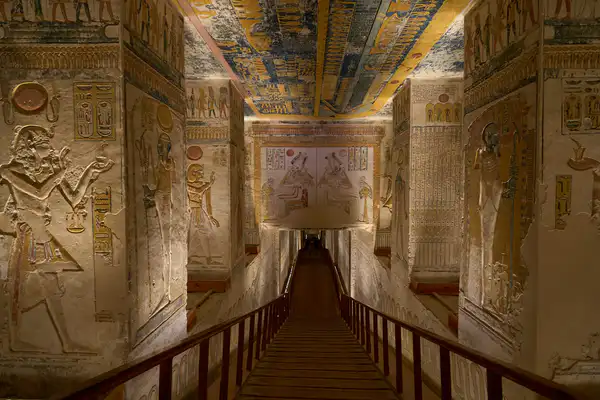
s New Kingdom — the empire's golden age — the most powerful pharaohs in the ancient world chose this remote, sun-scorched valley as their final resting place, filling it with 65 known tombs of extraordinary artistic and architectural complexity. The valley was chosen for its natural pyramid-shaped peak, el-Qurn ("the Horn"), which towers above it like a natural echo of the man-made pyramids the pharaohs had abandoned centuries earlier. The remote location, accessible only through a narrow wadi guarded by a dedicated police force called the Medjay, was intended to protect the royal burials from the tomb robbers who had systematically looted the exposed pyramids of the Old and Middle Kingdoms. This strategy ultimately failed — virtually every tomb was robbed in antiquity — but the valley itself survived intact, preserving some of the finest art ever created by human hands. The tombs range from simple single-chamber burials to vast underground complexes extending hundreds of meters into the rock. The walls are covered with elaborate paintings and carved reliefs depicting the pharaoh's journey through the Underworld, scenes from the Book of the Dead, the Book of Gates, and the Amduat, and images of the deceased king in the company of gods. The colors — brilliant blues, vivid reds, gleaming golds — remain remarkably preserved in the dry darkness, as fresh and vibrant as the day they were applied over three thousand years ago.
Historical Significance
“The Valley of the Kings represents the most concentrated collection of royal power and artistic achievement in the ancient world. During Egypt's New Kingdom — the era of Hatshepsut, Thutmose III, Akhenaten, Tutankhamun, Seti I, and Ramesses II — the valley served as the exclusive burial ground for the most powerful rulers on Earth, each competing to create a more elaborate and beautiful tomb than his predecessors. The decision to abandon pyramid burials in favor of hidden rock-cut tombs marked a fundamental shift in Egyptian royal funerary practice. Rather than advertising their location with massive monuments visible for miles, the New Kingdom pharaohs concealed their tombs in a remote valley, relying on secrecy and guards rather than sheer mass for protection. The sacred artisans who decorated these tombs lived in the purpose-built village of Deir el-Medina, forming a hereditary community of painters, sculptors, and scribes whose work represents the pinnacle of Egyptian artistic achievement. The valley achieved worldwide fame in 1922 with Howard Carter's discovery of the nearly intact tomb of Tutankhamun (KV62), the only royal burial found with its treasures substantially preserved. The golden death mask, the nested coffins, and the thousands of grave goods astonished the world and transformed public understanding of ancient Egyptian civilization. The valley continues to yield discoveries: as recently as 2005-2008, two new tombs (KV63 and KV64) were identified, suggesting more may remain hidden.”
故事
3History
👑 Built by
Pharaohs of the 18th, 19th, and 20th Dynasties
c. 1539 BC - First royal tomb (Thutmose I, KV38) carved in the valley
c. 1458 BC - Hatshepsut's tomb (KV20) completed, one of the deepest in the valley
c. 1279 BC - Seti I's tomb (KV17) created — the longest and most decorated
c. 1110 BC - Systematic tomb robberies documented in the Tomb Robbery Papyri
c. 1070 BC - Priests relocate royal mummies to hidden caches for protection
1738 - Richard Pococke publishes first Western map of the valley
1817 - Giovanni Belzoni discovers the tomb of Seti I (KV17)
1898 - Victor Loret discovers the Royal Cache in KV35 (Amenhotep II's tomb)
November 4, 1922 - Howard Carter discovers the tomb of Tutankhamun (KV62)
1979 - UNESCO World Heritage Site inscription (Ancient Thebes with its Necropolis)
1995 - Kent Weeks rediscovers and begins excavation of KV5 (150+ chambers)
2005-2008 - Discovery of tombs KV63 and KV64