
About
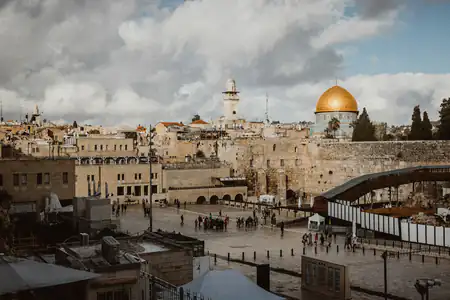
No place on Earth concentrates more spiritual power, contested memory, and accumulated sacredness into a smaller space than the Old City of Jerusalem. Enclosed within Ottoman-era walls that stretch just 4.5 kilometers around a walled area of barely 0.9 square kilometers, this ancient citadel perched on the Judean hills contains sites of supreme holiness to Judaism, Christianity, and Islam — three faiths representing over half of humanity. Within these walls, King David established his capital three thousand years ago, Solomon built the First Temple to house the Ark of the Covenant, Jesus of Nazareth was crucified and (Christians believe) rose from the dead, and the Prophet Muhammad ascended through the seven heavens during the miraculous Night Journey. Nowhere else do the fault lines of human belief run so deep, so close together, or with such incandescent intensity. The Temple Mount — known in Hebrew as Har HaBayit and in Arabic as al-Haram al-Sharif (the Noble Sanctuary) — dominates the Old City's southeastern corner as the most contested sacred precinct on the planet. For Jews, this 37-acre platform is the Foundation Stone (Even HaShetiyah) upon which God created the world, where Abraham bound Isaac for sacrifice, and where both the First Temple of Solomon (c. 957 BC) and the Second Temple of Herod (rebuilt 19 BC) once stood as the center of Jewish spiritual life. The Western Wall (HaKotel HaMa'aravi), a 488-meter retaining wall of massive Herodian limestone blocks — some weighing over 500 tons — is the closest point of prayer to the Temple's Holy of Holies and has been Judaism's most sacred site of worship and lamentation for centuries. For Muslims, this is the place where the Prophet Muhammad was transported from Mecca during the Isra (Night Journey) described in Surah 17:1 of the Quran, and from the Foundation Rock ascended through the heavens (Mi'raj) accompanied by the Angel Jibril, meeting the prophets Ibrahim, Musa, and Isa before standing in the presence of God. The Dome of the Rock (Qubbat al-Sakhrah), completed in 691 AD by Umayyad Caliph Abd al-Malik ibn Marwan, shelters this sacred stone beneath its golden dome — one of the oldest and most sublime works of Islamic architecture in existence. Nearby, the Al-Aqsa Mosque, the third holiest mosque in Islam after those in Mecca and Medina, can accommodate 5,000 worshippers. In the Christian Quarter, the Church of the Holy Sepulchre stands over the sites that most Christians identify as both Golgotha (Calvary), the hill of crucifixion, and the tomb from which Jesus rose on the third day. First built by Emperor Constantine in 335 AD after his mother Helena identified the sites, the church has been destroyed, rebuilt, burned, and restored across seventeen centuries. Today it is shared — often in uneasy coexistence — by six Christian denominations: Roman Catholic, Greek Orthodox, Armenian Apostolic, Coptic, Ethiopian, and Syriac Orthodox, each jealously guarding their portion of the church under the terms of the Status Quo agreement established in 1757. Each year during Holy Week, the miraculous Ceremony of the Holy Fire draws tens of thousands of Orthodox faithful who believe that sacred fire descends supernaturally upon the tomb of Christ — a tradition dating to at least the 9th century. So sensitive is the balance of power within the church that a wooden ladder placed on a window ledge above the entrance has remained in the exact same position since the mid-18th century, because no single denomination has authority to move it. The Old City's four traditional quarters — Jewish, Muslim, Christian, and Armenian — are layered upon thousands of years of continuous habitation, with remains spanning from the Canaanite period (c. 3000 BC) through the Jebusite, Israelite, Babylonian, Persian, Hellenistic, Roman, Byzantine, early Islamic, Crusader, Ayyubid, Mamluk, and Ottoman periods to the present day. The Via Dolorosa traces the path Christians believe Jesus carried his cross, its fourteen Stations of the Cross drawing millions of pilgrims annually. The Cardo, the ancient Roman main street, has been excavated to reveal its original 6th-century Byzantine grandeur. Beneath the streets, tunnels extend for hundreds of meters along the Western Wall, revealing Herodian stonework of staggering scale. The entire Old City was inscribed as a UNESCO World Heritage Site in 1981 on the nomination of Jordan, and placed on the List of World Heritage in Danger in 1982 — a status it retains to this day — reflecting the extraordinary fragility and political complexity of this irreplaceable place. Jerusalem is not merely a city with history; it is a city that has shaped the consciousness of civilizations, a place where the past is never past, and where stones themselves seem to vibrate with the prayers of three millennia.
Historical Significance
“Jerusalem holds a position in human history that is utterly singular. No other city has been so central to the spiritual, theological, and political identity of so many people for so long. The Hebrew Bible records that King David conquered the Jebusite city around 1000 BC and made it his capital, a strategic masterstroke that united the northern and southern Israelite tribes on neutral ground. His son Solomon built the First Temple (Beit HaMikdash) on the threshing floor of Araunah the Jebusite, creating the supreme cult center of the Israelite religion and the dwelling place of the Ark of the Covenant. When the Babylonian king Nebuchadnezzar II destroyed the Temple in 586 BC and deported the Jewish elite to Babylon, the resulting trauma shaped Judaism permanently — the prayers, the psalms, the eternal longing to return ('If I forget thee, O Jerusalem, let my right hand forget her cunning') all emerged from this catastrophe. The Second Temple, rebuilt after the Persian liberation and massively expanded by Herod the Great into one of the ancient world's most magnificent structures, was destroyed by Roman legions under Titus in 70 AD, an event that transformed Judaism from a temple-based sacrificial religion into the text-based, rabbinical tradition that exists today. For Christianity, Jerusalem is the city of the Passion, Resurrection, and early Church. Jesus wept over Jerusalem, entered it in triumph on Palm Sunday, overturned the money-changers' tables in the Temple, held the Last Supper in an upper room on Mount Zion, prayed in the Garden of Gethsemane, was tried before Pontius Pilate, and was crucified and buried at the site now enclosed within the Church of the Holy Sepulchre. The earliest Christian community was headquartered in Jerusalem under James the Just. When Emperor Constantine legalized Christianity in 313 AD, his mother Helena traveled to Jerusalem and, according to tradition, discovered the True Cross. The church built over the tomb became Christendom's most sacred shrine. The Crusades (1096-1291) were fundamentally wars to control Jerusalem — the First Crusade's capture of the city in 1099 and the establishment of the Latin Kingdom of Jerusalem represented the pinnacle of medieval Christian military pilgrimage, while Saladin's reconquest in 1187 remains one of the defining moments of Islamic military history. For Islam, Jerusalem (Al-Quds, 'The Holy') is the third holiest city after Mecca and Medina. The Quran's reference to 'the farthest mosque' (al-masjid al-aqsa) in the account of the Prophet Muhammad's Night Journey has been identified with the Temple Mount since the earliest period of Islam. The construction of the Dome of the Rock in 691 AD by the Umayyad caliph Abd al-Malik was one of the first great acts of Islamic monumental architecture, its octagonal form and golden dome deliberately designed to rival and surpass the Church of the Holy Sepulchre. The building's interior mosaics contain some of the earliest surviving Quranic inscriptions and represent a theological statement of Islam's relationship to the earlier Abrahamic faiths. UNESCO inscribed the Old City and its Walls in 1981, recognizing its outstanding universal value to humanity. The site was placed on the World Heritage in Danger list in 1982 due to uncontrolled development, tourism degradation, and the ongoing political conflict — a status that persists, reflecting Jerusalem's position as perhaps the most politically sensitive cultural site on Earth.”
Истории
3History
👑 Built by
King David (capital ~1000 BC), King Solomon (First Temple ~957 BC), King Herod (Second Temple expansion ~19 BC), Emperor Constantine (Holy Sepulchre 335 AD), Caliph Abd al-Malik (Dome of the Rock 691 AD), Sultan Suleiman the Magnificent (current walls 1535-1542)
~3000 BC - Earliest Canaanite settlement on the Ophel ridge; city known as 'Rusalimum' in Egyptian Execration Texts
~1400 BC - Jerusalem (Urusalim) appears in the Amarna Letters as a vassal city-state under Egyptian suzerainty
~1000 BC - King David captures the Jebusite city and establishes Jerusalem as the capital of the united Israelite kingdom
~957 BC - King Solomon completes the First Temple (Beit HaMikdash) on Mount Moriah
586 BC - Babylonian King Nebuchadnezzar II destroys the First Temple and deports the Jewish population to Babylon
516 BC - Second Temple completed after the Persian King Cyrus the Great permits the Jews to return
~19 BC - Herod the Great begins massive expansion of the Second Temple, doubling the Temple Mount platform to 37 acres
~30-33 AD - Crucifixion and (in Christian belief) resurrection of Jesus of Nazareth in Jerusalem
70 AD - Roman legions under Titus destroy the Second Temple; only the Western Wall retaining walls survive
135 AD - Emperor Hadrian rebuilds Jerusalem as the Roman colony Aelia Capitolina; Jews banned from the city
335 AD - Emperor Constantine dedicates the Church of the Holy Sepulchre over the site of Christ's tomb
~621 AD - The Prophet Muhammad's Isra and Mi'raj (Night Journey and Ascension) from al-Masjid al-Aqsa
638 AD - Caliph Umar ibn al-Khattab conquers Jerusalem peacefully; prays at the Temple Mount and guarantees Christian and Jewish rights
691 AD - Umayyad Caliph Abd al-Malik completes the Dome of the Rock over the Foundation Stone
1009 - Fatimid Caliph al-Hakim orders destruction of the Church of the Holy Sepulchre
1099 - First Crusade captures Jerusalem; Crusaders establish the Latin Kingdom of Jerusalem
1187 - Saladin (Salah ad-Din) reconquers Jerusalem after the Battle of Hattin; allows Christian pilgrimage to continue
1229 - Emperor Frederick II negotiates a treaty returning Jerusalem to Christian control without a battle
1244 - Khwarezmian Turks sack Jerusalem; the city passes permanently out of Crusader hands
1517 - Ottoman Sultan Selim I conquers Jerusalem
1535-1542 - Sultan Suleiman the Magnificent rebuilds the city walls — the walls that stand today
1917 - British General Allenby enters Jerusalem on foot out of respect; beginning of the British Mandate
1948 - State of Israel declared; Jerusalem divided between Israel (west) and Jordan (east, including Old City)
1967 - Six-Day War; Israel captures the Old City; soldiers reach the Western Wall
1981 - UNESCO World Heritage Site inscription (proposed by Jordan)
1982 - Placed on the List of World Heritage in Danger, where it remains today