
About
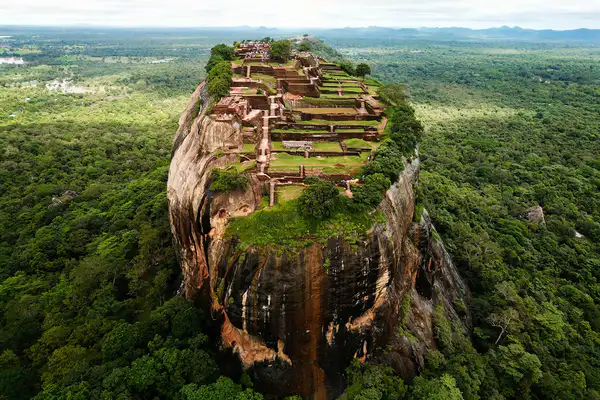
Rising nearly 200 meters above the surrounding jungle canopy of central Sri Lanka, Sigiriya — the Lion Rock — is one of the most dramatic and haunting monuments in all of Asia. This colossal column of magma-hardened rock, the eroded plug of an ancient volcano, was transformed in the 5th century CE into an impregnable sky fortress and royal palace by King Kashyapa I, a patricide prince who murdered his own father and seized the throne from his rightful brother. For eighteen years, Kashyapa ruled from his palace in the clouds, surrounded by pleasure gardens, frescoed galleries of celestial maidens, and engineering marvels that still astonish modern hydraulic experts. The fortress was both a statement of supreme power and a monument to supreme guilt — a king who could trust no one, perched above the world he had betrayed. The approach to Sigiriya is a masterwork of theatrical architecture designed to overwhelm visitors with awe. The journey begins in the meticulously planned water gardens at the base — a symmetrical complex of pools, fountains, and island pavilions connected by sophisticated hydraulic systems so precisely engineered that the ancient fountains still function when monsoon rains fill the reservoirs. Visitors then ascend through the boulder gardens, a landscape of massive fallen rocks sculpted into meditation caves and audience halls, before reaching the Mirror Wall — a polished plaster surface so reflective that the king could see his own reflection as he walked. Over eight centuries, visitors scratched more than 1,800 verses of poetry and graffiti into this wall in ancient Sinhalese, creating one of the oldest collections of secular writing in the world. Nearby, a sheltered gallery once displayed an estimated 500 frescoes of bare-breasted celestial women — the famous Cloud Maidens, or Sigiri Apsaras — of which only 21 survive today, their colors still vivid after fifteen hundred years. The climb reaches its most breathtaking moment at the Lion Gate, the original entrance to the upper palace. Here, visitors once walked directly into the open jaws of a colossal brick-and-plaster lion — entering through its mouth and ascending through its throat to reach the summit. Today only the enormous paws survive, each one taller than a man, flanking the final stairway carved into the sheer rock face. The name Sigiriya itself derives from this gateway: Sinhagiri, the Lion Rock. At the summit, spread across a plateau of nearly 1.6 hectares, lie the ruins of Kashyapa's palace complex — throne platforms, bathing pools carved from living rock, a cistern that still holds water, and the foundations of buildings that once rose multiple stories above the clouds. Sigiriya is far more than a fortress; it is a complete royal city frozen in time, a window into the sophistication of ancient Sri Lankan civilization, and one of the finest surviving examples of ancient urban planning in Asia. The water gardens represent some of the most advanced hydraulic engineering of the ancient world, incorporating surface and subsurface water management, gravity-fed fountains, and an irrigation network that sustained the fortress complex. UNESCO designated Sigiriya a World Heritage Site in 1982, recognizing it as a masterpiece that combines urban planning, architecture, engineering, gardening, painting, and sculpture into a single extraordinary creation — the work of a brilliant, tormented king who built paradise on a rock and lost everything.
Historical Significance
“Sigiriya's history is inseparable from the bloody saga of King Kashyapa I and the Moriya dynasty of ancient Sri Lanka. Around 473 CE, Prince Kashyapa — the eldest son of King Dhatusena but born to a non-royal consort — grew fearful that his father would pass the throne to his younger half-brother Moggallana, whose mother was of royal blood. Driven by ambition and paranoia, Kashyapa conspired with Migara, a military commander who nursed his own grudge against the king. Together they overthrew Dhatusena, and Kashyapa demanded that his father reveal the location of the royal treasury. When the aging king led them to the great Kalavapi reservoir and gestured at the water, declaring "This is my wealth" — meaning he had spent the kingdom's riches on public works — Kashyapa flew into a rage. According to the Sinhalese chronicles, he had his father walled up alive within the bund of the very reservoir Dhatusena had built. Moggallana, fearing for his life, fled to southern India to raise an army. Kashyapa, knowing that his brother would eventually return with Indian forces, abandoned the traditional capital of Anuradhapura and relocated his court to the massive rock of Sigiriya, transforming it into the most spectacular fortress-palace in the ancient world. The choice was both strategic and psychological: the rock was virtually unassailable, visible for miles in every direction, and its summit provided a perfect defensive position. But Kashyapa did not merely build a military fortification — he created an entire royal city that proclaimed his legitimacy and divine right to rule. The frescoes of celestial maidens may have represented apsaras (heavenly nymphs) associated with the divine king, while the Lion Gate entrance symbolized royal authority. The entire complex was designed as a mandala — a sacred cosmological diagram — with the king's palace at its summit representing Mount Meru, the center of the Buddhist-Hindu universe. For eighteen years (477-495 CE), Kashyapa ruled from his sky palace, but the reckoning came when Moggallana finally returned from India with a Tamil mercenary army. Rather than shelter behind his impregnable walls, Kashyapa rode out to meet his brother on the plains below — perhaps from overconfidence, perhaps from guilt, perhaps to spare his creation from siege. During the battle, Kashyapa's elephant turned aside to avoid a marshy patch of ground, and his troops, interpreting the movement as a retreat, broke ranks and abandoned their king. Surrounded and defeated, Kashyapa drew his own dagger and slit his throat rather than submit to capture. Moggallana, now King Moggallana I, converted Sigiriya into a Buddhist monastery, and monks inhabited the rock for centuries. The fortress was eventually abandoned and swallowed by the jungle until British archaeologist H.C.P. Bell began excavations in 1898, revealing one of the greatest archaeological treasures in South Asia.”
القصص
5History
👑 Built by
King Kashyapa I (Kasyapa I)
3rd century BCE - Rock shelters at Sigiriya used by Buddhist monks; drip-ledge caves carved for meditation
~473 CE - Prince Kashyapa overthrows and kills his father King Dhatusena; brother Moggallana flees to India
~477 CE - Kashyapa I moves the capital from Anuradhapura to Sigiriya; begins construction of the fortress-palace
~477-485 CE - Water gardens, boulder gardens, and ramparts constructed at the base of the rock
~480 CE - Cloud Maiden frescoes painted in the sheltered gallery on the western face; estimated 500 figures originally
~480-490 CE - Mirror Wall constructed and polished to a high sheen; Lion Gate entrance built at the northern face
~485-495 CE - Summit palace complex completed with throne platforms, cisterns, and bathing pools
495 CE - Moggallana returns from India with an army; Kashyapa rides out to battle, is abandoned by his troops, and slits his own throat
495 CE onward - Moggallana I converts Sigiriya into a Buddhist monastery; capital returns to Anuradhapura
6th-14th century CE - Buddhist monks occupy the rock; Mirror Wall accumulates over 1,800 verses of graffiti poetry
14th century CE - Sigiriya gradually abandoned; jungle reclaims the site
1831 - British colonial officer Major Jonathan Forbes rediscovers Sigiriya during a jungle expedition
1898 - British archaeologist H.C.P. Bell begins first systematic excavations
1982 - UNESCO designates Sigiriya as a World Heritage Site