
About
Knossos, rising from the hills south of Heraklion, Crete, is the largest Bronze Age archaeological site in Europe and the legendary home of King Minos, the Labyrinth, and the Minotaur. This was the center of Minoan civilization — Europe's first advanced society, which flourished for over a thousand years before the classical Greeks were born. The palace complex sprawls across five acres, a maze of over 1,300 interlocking rooms arranged around a central courtyard. Multi-story buildings, elaborate drainage systems, flushing toilets, and advanced ventilation made Knossos more sophisticated than most cities that would be built for the next three thousand years. Light wells illuminated interior spaces; storage magazines held massive clay jars (pithoi) of oil, wine, and grain; throne rooms featured Europe's oldest surviving throne. The Minoans left no readable historical records — their Linear A script remains undeciphered — so their civilization is known primarily through their art: breathtaking frescoes of bull-leaping athletes, dolphins dancing, ladies in elaborate dresses, and processions of tribute-bearers. The famous "Prince of the Lilies" fresco, the "Blue Ladies," and the "Bull-Leaping Fresco" revolutionized our understanding of ancient art. The labyrinthine nature of the palace — with its endless corridors, multiple levels, and confusing layout — gave rise to the legend of the Labyrinth, the maze built by Daedalus to contain the Minotaur. Whether an actual minotaur existed, the palace was certainly associated with bull worship: horns of consecration crowned every building, bull-leaping appears in countless frescoes, and the word "Labyrinth" itself may derive from "labrys," the double-headed axe sacred to the Minoans. The civilization ended suddenly around 1450 BCE — perhaps due to volcanic eruption, earthquake, invasion, or all three. The Mycenaean Greeks took over the ruins, leaving their Linear B tablets (which can be read) before the palace was finally abandoned. When Sir Arthur Evans began excavating in 1900, he found a world that had been lost for over three thousand years.
Historical Significance
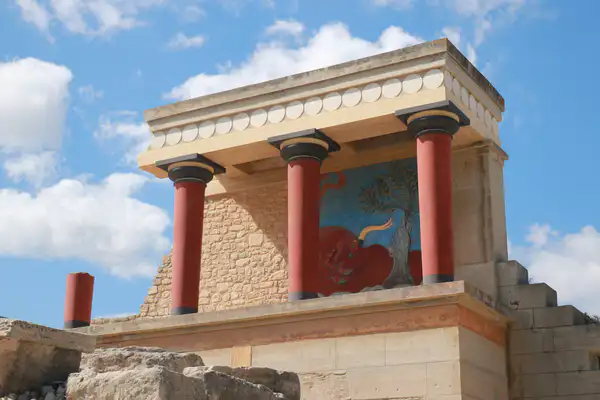
“Knossos represents Europe's first great civilization and the oldest advanced society in the Western world. The Minoans developed writing (Linear A, still undeciphered), advanced architecture, sophisticated art, and extensive trade networks over a thousand years before classical Greece. The civilization was named "Minoan" by excavator Arthur Evans after King Minos of Greek legend. Whether Minos was a single historical king or a title (like "Pharaoh" or "Caesar") is unknown. The Minoans did not call themselves Minoans — we don't know what they called themselves. Their influence on later Greek culture was profound. The myths of Theseus and the Minotaur, Daedalus and Icarus, Europa and the Bull, Ariadne and Dionysus — all originate in Minoan Crete. The later Greeks remembered the Minoans as a powerful sea empire that had dominated the Aegean before them. The palace was destroyed and rebuilt multiple times, probably due to earthquakes. The final destruction around 1450 BCE coincided with the Mycenaean Greek takeover. Linear B tablets from this period show that Greek speakers had taken control and were administering the palace using Minoan bureaucratic methods. Evans' reconstruction of the palace (1900-1930) is controversial. He rebuilt portions in concrete, painted the columns red, and restored frescoes based on fragments. Critics argue he imposed his own interpretation on ambiguous evidence. Defenders note that his reconstructions help visitors understand the original scale and color. The debate continues: how much should archaeologists preserve, and how much should they interpret?”
Historias
5History
👑 Built by
Minoan civilization (legendary: Daedalus)
~7000 BCE - Neolithic settlement at the site
~2700 BCE - Early Minoan period begins; first structures
~1900 BCE - First palace constructed
~1700 BCE - First palace destroyed (earthquake?); new palace built
~1628 BCE - Thera (Santorini) volcanic eruption — possible Minoan impact
~1450 BCE - Destruction of Minoan palaces across Crete; Mycenaean takeover
~1400 BCE - Final destruction of Knossos palace
~1375 BCE - Site continues as reduced settlement
~1100 BCE - Abandonment during Bronze Age collapse
1878 - Minos Kalokairinos discovers the site
1900 - Sir Arthur Evans begins excavations
1900-1930 - Evans reconstructs and restores portions of the palace
1941-1945 - German occupation; site protected
1979 - Listed as UNESCO World Heritage tentative site
2000-present - Ongoing conservation and study