
About
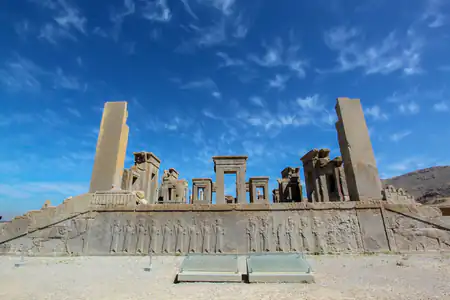
Persepolis — Takht-e Jamshid, the Throne of Jamshid — was the ceremonial capital of the Achaemenid Empire, the greatest power the ancient world had ever seen. Built on a massive stone terrace at the foot of Kuh-e Rahmat (the Mountain of Mercy) in the plains of Fars province, this palatial complex was the stage upon which the King of Kings received tribute from twenty-three nations stretching from Libya to India, from the Danube to the Oxus. At its zenith under Darius I and Xerxes I, Persepolis was not merely a palace but a cosmic theater — an architectural declaration that the Achaemenid king held the world in order. Construction began around 518 BCE when Darius I chose this site on the Marv Dasht plain, fifty kilometers northeast of modern Shiraz. Over the next sixty years, three generations of kings — Darius I, Xerxes I, and Artaxerxes I — carved a terrace 125,000 square meters in area from the living rock, raising it 14 meters above the plain. Upon this platform rose a succession of monumental structures: the Apadana (audience hall) with its forest of 36 columns each standing 20 meters tall; the Gate of All Nations where delegations from every corner of the empire entered beneath colossal winged bulls; the Throne Hall (Hall of a Hundred Columns) where the king sat enthroned before his subjects; the Tachara (Palace of Darius) with its exquisite carved reliefs; and the Treasury where the accumulated wealth of the ancient world was stored. The Apadana staircase reliefs are among the supreme masterpieces of ancient art. Carved with extraordinary precision and sensitivity, they depict delegations from twenty-three subject nations — Medes in rounded caps, Elamites bearing lion cubs, Babylonians with humped bulls, Indians carrying gold dust, Ethiopians with elephant tusks, Scythians in pointed hats — each rendered with such ethnographic accuracy that scholars can identify their costumes, hairstyles, weapons, and gifts. Unlike the militaristic reliefs of Assyria, the Persepolis carvings show these peoples walking in dignity, not in chains. They come bearing tribute willingly — or so the imperial propaganda proclaimed — united under the benevolent rule of the King of Kings. The glory of Persepolis ended in a single catastrophic night. In 330 BCE, Alexander of Macedon, after conquering the Persian Empire in a series of stunning victories, entered Persepolis and allowed his army to plunder its treasures — wealth so vast that it reportedly required 20,000 mules and 5,000 camels to carry it away. According to ancient sources, during a drunken banquet the Athenian courtesan Thais urged Alexander to burn the palace as revenge for Xerxes' burning of Athens 150 years earlier. Alexander seized a torch, Thais threw the second, and the cedar-beamed roofs of the greatest palace in the ancient world went up in flames. Though Alexander reportedly regretted the act immediately, the damage was done. The fire was so intense that archaeologists found the stone columns cracked and the mud-brick walls vitrified. Today, the ruins of Persepolis rise from the Iranian plateau like a forest of broken columns and carved stone — still magnificent, still defiant, still proclaiming the ambition of an empire that once held the world. Inscribed as a UNESCO World Heritage Site in 1979, Persepolis remains the supreme symbol of ancient Persian civilization and a source of profound national pride for Iranians, who know it by its mythological name: the Throne of Jamshid, the legendary king of the Shahnameh who ruled over a golden age when death and sickness did not exist.
Historical Significance
“Persepolis represents the architectural and political zenith of the Achaemenid Empire, the first true world empire in human history. At its peak under Darius I and Xerxes I, the Achaemenid realm stretched from Egypt and Libya in the west to the Indus Valley in the east, from the steppes of Central Asia to the shores of the Persian Gulf — encompassing roughly 44% of the world's population, the highest percentage any empire has ever held. Persepolis was the symbolic center of this vast dominion, the place where the empire's diversity was celebrated, codified, and displayed in stone for eternity. The significance of the Apadana reliefs cannot be overstated. They constitute the most comprehensive ethnographic survey of the ancient world, depicting peoples from twenty-three nations with such accuracy that modern scholars use them to study the clothing, weapons, animals, and trade goods of civilizations that left few records of their own. The reliefs also embody a remarkable political philosophy: unlike the Assyrian palace reliefs that glorified conquest and brutality, the Persepolis carvings depict the subject peoples as dignified participants in a harmonious world order. This reflects the Achaemenid ideology of governance — expressed in the Behistun Inscription and the Daiva Inscription — in which the king ruled not by terror alone but by maintaining arta (truth, cosmic order) against drauga (the lie, chaos). It was the world's first experiment in multicultural imperial governance, allowing subject peoples to keep their languages, religions, and customs. The burning of Persepolis by Alexander in 330 BCE is one of the most symbolically charged events in ancient history. It marked the definitive end of the Achaemenid Empire and the beginning of the Hellenistic age. Yet the act was controversial even in Alexander's time — his general Parmenion reportedly argued against it, saying it would alienate the Persian population Alexander now claimed to rule. The destruction was incomplete, however, and the stone reliefs, columns, and foundations survived to be rediscovered by European travelers in the 17th century. Systematic excavation by Ernst Herzfeld and Erich Schmidt in the 1930s revealed the full magnificence of the site. For Iranians, Persepolis holds a significance comparable to the Acropolis for Greeks or the Colosseum for Italians — it is the physical embodiment of national identity. The Persian name Takht-e Jamshid connects the ruins to the mythological golden age described in Ferdowsi's Shahnameh, the Persian national epic. The Nowruz (Persian New Year) celebrations that may have been held here over 2,500 years ago are still observed by hundreds of millions of people across Central Asia, the Caucasus, and the Middle East, making Persepolis the origin point of one of the oldest continuously celebrated festivals on Earth.”
Historias
5History
👑 Built by
Darius I (the Great), continued by Xerxes I and Artaxerxes I
~518 BCE - Darius I begins construction of the terrace and the Apadana at Persepolis
~515 BCE - The Tachara (Palace of Darius) completed; earliest finished structure on the terrace
~486 BCE - Darius I dies; Xerxes I inherits the throne and continues construction on a grand scale
~480 BCE - Xerxes begins the Gate of All Nations and the Throne Hall (Hall of a Hundred Columns)
~470 BCE - The Hadish (Palace of Xerxes) completed; the largest residential palace on the terrace
~465 BCE - Xerxes I assassinated; Artaxerxes I continues building and adds the unfinished gate
~460-450 BCE - Artaxerxes I completes the Hall of a Hundred Columns and the remaining structures
334-331 BCE - Alexander of Macedon defeats Darius III at Granicus, Issus, and Gaugamela
330 BCE - Alexander captures Persepolis; allows his army to plunder the treasury
330 BCE - The great burning: Alexander torches the palaces, reportedly at the urging of Thais
3rd century CE - Sasanian kings carve rock reliefs at nearby Naqsh-e Rostam, linking themselves to Achaemenid glory
1620 CE - Spanish ambassador Garcia de Silva Figueroa becomes the first European to correctly identify the ruins as Persepolis
1931-1939 - Oriental Institute of Chicago (Ernst Herzfeld, then Erich Schmidt) conducts systematic excavation
1971 - Shah Mohammad Reza Pahlavi holds the 2,500-year celebration of the Persian Empire at Persepolis
1979 - UNESCO inscribes Persepolis as a World Heritage Site