
About
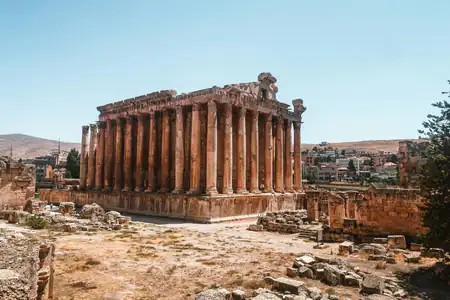
Baalbek is one of the most awe-inspiring and enigmatic archaeological sites on Earth — a colossal temple complex in Lebanon's Beqaa Valley that represents the most ambitious construction project the Roman Empire ever attempted, built upon foundations so massive and mysterious that they have defied explanation for millennia. Known to the Romans as Heliopolis ("City of the Sun"), this sacred precinct contains the largest and most ornate temples ever built in the Roman world, raised upon a platform of stones so immense that modern engineering still struggles to explain how they were moved and placed with such precision. The site's origins predate Rome by thousands of years. Long before the first Roman column was erected, this fertile plain between the Lebanon and Anti-Lebanon mountain ranges was sacred to the Canaanites and Phoenicians, who worshipped Baal (the "Lord" of the sky and storms) here from at least the Early Bronze Age, around 2900-2300 BC. The name Baalbek itself derives from "Baal of the Beqaa" — the lord of this valley. When Alexander the Great's successors brought Hellenistic culture to the region, the local Baal was syncretized with the Greek Zeus and later the Roman Jupiter. Under Roman rule, beginning with Pompey's conquest in 64 BC, what had been a regional Phoenician shrine was transformed over three centuries into the most grandiose temple complex in the entire empire. The Temple of Jupiter Heliopolitanus, begun under Augustus around 16 BC and not completed until the reign of Nero around 60 AD, was the largest religious structure in the entire Roman world. Its sanctuary measured approximately 90 by 50 meters and was surrounded by 54 Corinthian columns, each standing 22.9 meters tall (roughly 75 feet) with a diameter of 2.2 meters — the tallest columns ever erected in the ancient world. Only six of these titanic columns remain standing today, but even these six remnants are among the most photographed and recognizable ruins on the planet, their immense scale conveying the almost incomprehensible ambition of the builders. The entablature and pediment above them added another 5 meters, bringing the total height of the temple facade to nearly 28 meters. But the true mystery of Baalbek lies beneath the Temple of Jupiter, in the megalithic platform upon which it was built. The western retaining wall of the temple podium incorporates the famous Trilithon — three colossal limestone blocks, each weighing approximately 800 metric tons, measuring roughly 19 meters long, 4.3 meters high, and 3.6 meters wide. These are among the largest building stones ever used in human construction. Even more astonishing, in the nearby quarry approximately 900 meters to the south, three even larger stones remain where they were cut but never moved. The Stone of the Pregnant Woman (Hajjar al-Hibla, حجر الحبلى) weighs an estimated 1,000 metric tons and measures 20.6 meters long, 4 meters wide, and 4.3 meters high. Beside it lies the Stone of the South, discovered in the 1990s, weighing an extraordinary 1,242 metric tons. And in 2014, a third quarry stone was discovered beneath the Stone of the South, estimated at an almost unbelievable 1,650 metric tons — making it the largest worked stone ever found on Earth, measuring 19.6 meters long, 6 meters wide, and 5.5 meters tall. The Temple of Bacchus, built between approximately 150 and 250 AD, stands remarkably intact and is widely considered the best-preserved Roman temple in the world. Though called "small" by comparison with the Temple of Jupiter, it is in fact larger than the Parthenon in Athens. It measures 69 meters long and 36 meters wide, ringed by 42 Corinthian columns standing 19 meters tall, and its interior cella preserves extraordinary carved decoration — fluted Corinthian half-columns, niches framed by arched pediments, and a monumental doorway 13 meters high whose lintel is decorated with an eagle clutching sheaves of wheat, flanked by intricate vine scrolls inhabited by birds, erotes, and other figures. The smaller circular Temple of Venus, built in the 3rd century AD, showcases a unique concave entablature that represents one of the most innovative architectural experiments of the Roman Baroque period. Arab legends ascribe Baalbek's construction to supernatural forces — to Cain, son of Adam, who supposedly built it as a refuge after murdering Abel; to the biblical Nimrod, who commanded giants or djinn to raise the stones; or to King Solomon, who marshaled legions of spirits to erect the platform. Medieval Arab geographers like al-Idrisi and Yaqut al-Hamawi recorded these tales, reflecting the universal human inability to comprehend how mere mortals could have moved such stones. The site was converted into a fortress by the Umayyad caliphs in the 8th century, who built a mosque within the temple precinct, and later strengthened by the Ayyubids and Mamluks. Devastating earthquakes in 1170 and 1759 toppled many of the remaining columns. UNESCO inscribed Baalbek as a World Heritage Site in 1984, recognizing it as "one of the finest examples of Imperial Roman architecture at its apogee" and acknowledging the enduring mystery of its megalithic foundations.
Historical Significance
“Baalbek represents the most ambitious and monumental building project ever undertaken by the Roman Empire, and its megalithic foundations constitute one of the most enduring mysteries in the history of human construction. The site's significance spans at least five millennia of continuous sacred use, from Canaanite Baal worship through Phoenician, Hellenistic, Roman, Byzantine, and Islamic periods. The pre-Roman origins of Baalbek remain shrouded in mystery. Archaeological evidence confirms habitation from at least the Early Bronze Age (c. 2900-2300 BC), and the site was a significant Phoenician religious center dedicated to the storm god Baal-Hadad long before any Roman presence. When the Romans arrived, they did not build from scratch — they built upon and around pre-existing megalithic foundations whose origins and dating remain subjects of fierce scholarly debate. The Trilithon stones, each weighing approximately 800 tons, and the even larger quarry stones (up to 1,650 tons) have no parallel in Roman construction anywhere else in the empire. Some researchers argue that the megalithic podium predates the Roman construction phase entirely, potentially by centuries or even millennia, while others maintain that Roman engineers were capable of moving such stones using techniques now lost. The question remains open. The Roman construction at Baalbek, spanning roughly 250 years from Augustus to Caracalla, employed the finest architects and craftsmen in the empire and consumed resources on a scale that rivaled the construction of Rome itself. The Temple of Jupiter Heliopolitanus, with its 54 Corinthian columns each standing 22.9 meters tall, was the crowning achievement of Roman temple architecture — larger than any temple in Rome, including the Temple of Jupiter Optimus Maximus on the Capitoline Hill. The complex served a syncretic religious function, merging the indigenous Baal worship with the Roman Jupiter cult, and attracted pilgrims from across the Near East. The Temple of Bacchus, though overshadowed by Jupiter's temple in scale, is universally regarded as the finest surviving example of Roman temple architecture. Its state of preservation is remarkable — the cella walls, columns, entablature, and much of the ceiling survive intact, offering an unparalleled window into the grandeur of Roman religious architecture at its peak. The carved decoration of its interior rivals the finest work at any Roman site. After the Christianization of the Roman Empire, Emperor Theodosius ordered pagan temples closed in 391 AD, and a basilica was built in the Court of Jupiter. The Arab conquest of 637 AD transformed the temple precinct into a fortified citadel, and subsequent Islamic dynasties — Umayyad, Abbasid, Fatimid, Ayyubid, and Mamluk — added their own fortifications and structures. The devastating earthquakes of 1170 and 1759 caused catastrophic damage, reducing the Temple of Jupiter from 54 columns to six. UNESCO inscribed Baalbek as a World Heritage Site in 1984, and the site has become Lebanon's most iconic cultural landmark. The annual Baalbek International Festival, held among the temple ruins since 1956, has hosted performances by the world's greatest musicians and artists, maintaining the site's ancient tradition as a place where humanity gathers to celebrate something larger than itself.”
Historias
5History
👑 Built by
Roman emperors from Augustus to Caracalla (c. 16 BC - 3rd century AD); pre-Roman foundations attributed to Canaanite/Phoenician builders (origins debated)
c. 2900-2300 BC - Earliest evidence of Canaanite settlement and Baal worship at the site during the Early Bronze Age
c. 1000-333 BC - Phoenician temple precinct dedicated to Baal-Hadad flourishes as a regional pilgrimage center
333-64 BC - Hellenistic period; local Baal syncretized with Greek Zeus; site known as Heliopolis
64 BC - Pompey conquers the region; Roman rule begins; massive temple construction program initiated
c. 16 BC - 60 AD - Construction of the Temple of Jupiter Heliopolitanus under Augustus through Nero; 54 Corinthian columns erected
c. 150-250 AD - Construction of the Temple of Bacchus, now the best-preserved Roman temple in the world
3rd century AD - Temple of Venus constructed; Hexagonal Court completed
391 AD - Emperor Theodosius orders closure of pagan temples; Christian basilica built in the Court of Jupiter
637 AD - Arab conquest; temple precinct converted into a fortified citadel (Qalaa)
1170 - Major earthquake devastates the complex, toppling many columns
1759 - Another catastrophic earthquake causes further destruction
1898 - Kaiser Wilhelm II visits; German archaeological expeditions begin systematic study
1956 - Baalbek International Festival inaugurated among the temple ruins
1984 - UNESCO inscribes Baalbek as a World Heritage Site
2014 - Third quarry stone discovered, estimated at 1,650 metric tons — the largest worked stone ever found