
About
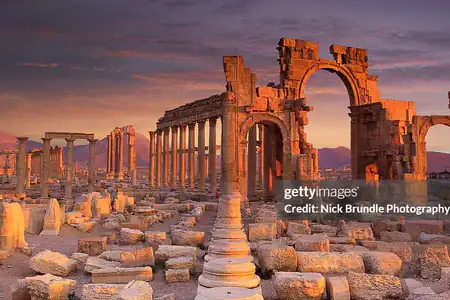
Palmyra rises from the Syrian desert like a mirage of colonnaded streets and shattered temples — the remains of one of the ancient world's most extraordinary cities. Known in Aramaic as Tadmur, a name often translated as "miracle" or "the indomitable," this oasis settlement evolved from a modest caravan stop into a breathtaking metropolis that rivaled Rome itself in ambition and beauty. Situated midway between the Mediterranean coast and the Euphrates River, Palmyra occupied the most strategic position on the ancient Silk Road, serving as the indispensable commercial bridge between the Roman Empire to the west and the Parthian (later Sassanid) Empire to the east. Caravans laden with Chinese silk, Indian spices, Arabian incense, and Persian pearls all passed through its gates, and the city grew fabulously wealthy by taxing this river of luxury goods flowing in both directions. The Great Colonnade, Palmyra's most iconic monument, stretches for 1.1 kilometers through the heart of the city — one of the longest colonnaded streets in the ancient world. Its soaring Corinthian columns, each standing over nine meters tall, once supported an ornate covered walkway that shielded merchants, diplomats, and citizens from the brutal desert sun. Unique brackets halfway up each column once held bronze portrait statues of the city's most prominent benefactors, a distinctly Palmyrene innovation that blended Roman architectural grammar with local Semitic traditions of honoring civic patrons. At its western end stood the monumental Temple of Bel, consecrated in 32 AD and considered one of the most important religious buildings of the first-century Near East. This colossal sanctuary blended Greco-Roman architecture with ancient Mesopotamian and Levantine religious traditions, its massive cella containing cult reliefs depicting Bel, Yarhibol, and Aglibol — the supreme triad of Palmyrene gods. But Palmyra's most unforgettable chapter belongs to Queen Zenobia, the warrior-queen who in 267 AD seized control of the city and launched one of antiquity's most audacious rebellions against Rome. Claiming descent from Cleopatra and the Ptolemaic dynasty of Egypt, Zenobia was described by ancient historians as extraordinarily beautiful, fiercely intelligent, and physically formidable — she hunted lions, rode at the head of her armies in full armor, and could outmarch her own soldiers on foot. Within five years, she conquered Egypt, much of Anatolia, and most of the Roman East, declaring her son emperor and herself regent of an independent Palmyrene Empire that stretched from the Nile to the Bosphorus. Emperor Aurelian finally defeated her in 272 AD after a grueling campaign, and Zenobia was paraded through the streets of Rome in golden chains — though ancient sources disagree on whether she was executed or lived out her days in comfortable exile at a villa in Tivoli. In the 21st century, Palmyra suffered a tragedy that shocked the world. When ISIS seized the city in May 2015, they systematically destroyed the Temple of Bel, the Temple of Baalshamin, the Arch of Triumph, and several of the iconic tower tombs — erasing in days what had endured for two millennia. Before the destruction, 82-year-old Khaled al-Asaad, the chief archaeologist who had devoted over fifty years of his life to excavating and protecting Palmyra, refused to reveal where ancient artifacts had been hidden. ISIS publicly beheaded him on August 18, 2015, and hung his body from one of the columns he had spent his life studying. His martyrdom became a global symbol of the struggle to protect cultural heritage against barbarism. Today, Palmyra remains on UNESCO's World Heritage in Danger list, its shattered columns standing as both a monument to human civilization and a warning of its fragility.
Historical Significance
“Palmyra represents one of the most remarkable examples of cultural synthesis in the ancient world. Unlike cities that were purely Greek, purely Roman, or purely Semitic, Palmyra forged a unique hybrid civilization that drew freely from all these traditions. Its architecture blended Corinthian columns with Mesopotamian temple plans. Its gods — Bel, Yarhibol, Aglibol, Allat, and Arsu — were Semitic deities worshipped in Greco-Roman architectural settings. Its citizens bore both Aramaic and Greek names, wrote in both languages, and dressed in a fusion of Roman togas and Parthian trousers. This cultural alchemy was not accidental but essential: as the commercial bridge between Rome and Parthia, Palmyra's survival depended on its ability to speak fluently to both civilizations. The rebellion of Queen Zenobia in 267-272 AD stands as one of the most dramatic episodes in Roman history. At a time when the Roman Empire was fragmenting under the Crisis of the Third Century — beset by civil wars, plague, and barbarian invasions — Zenobia exploited the chaos to carve out an independent empire that controlled the entire eastern Mediterranean trade network. Her conquests were not merely military but political and cultural: she patronized scholars including the philosopher Cassius Longinus, minted her own coinage, and positioned Palmyra as a legitimate successor state to Rome's eastern provinces. Her defeat by Aurelian ended the dream of an independent Palmyrene Empire, but Zenobia became an enduring symbol of female power, resistance, and ambition that resonates across Arab, Western, and feminist historiography to this day. The destruction wrought by ISIS in 2015 transformed Palmyra from an archaeological site into a global symbol of cultural heritage under threat. The deliberate demolition of the Temple of Bel — which had survived earthquakes, invasions, and centuries of neglect — represented not merely vandalism but an ideological assault on the plurality and syncretism that Palmyra embodied. The martyrdom of Khaled al-Asaad galvanized the international community and led to intensified efforts by UNESCO, ICOMOS, and governments worldwide to protect endangered heritage sites. Partial restoration work has begun, and 3D digital preservation projects have ensured that Palmyra's monuments survive at least in virtual form. But the ruins themselves, scarred and diminished, now carry a double weight of meaning: they testify both to the glories of the ancient world and to the ongoing struggle to protect humanity's shared inheritance.”
Historias
5History
👑 Built by
Aramean settlers (earliest), expanded by Seleucid Greeks, Roman emperors (especially during 1st-3rd centuries AD), and Palmyrene merchant aristocracy
~2000 BC - Earliest known references to Tadmur in Mesopotamian tablets (Mari archives)
~1100 BC - Tadmur mentioned in Assyrian records as an oasis settlement on caravan routes
64 BC - Pompey's conquest of Syria; Palmyra maintains semi-autonomous status under Rome
17-19 AD - Palmyra formally incorporated into the Roman province of Syria under Tiberius
32 AD - Temple of Bel consecrated, blending Greco-Roman and Mesopotamian architectural traditions
129 AD - Emperor Hadrian visits Palmyra and grants it the title 'Palmyra Hadriana'; free city status
212 AD - Septimius Odaenathus rises as Palmyrene leader; city elevated to Roman colony status
260 AD - Odaenathus defeats the Persians after Emperor Valerian's capture; becomes 'King of Kings'
267 AD - Odaenathus assassinated; Queen Zenobia seizes power as regent for her young son Vaballathus
270-271 AD - Zenobia conquers Egypt, Anatolia, and the Levant; declares independent Palmyrene Empire
272 AD - Emperor Aurelian defeats Zenobia at Emesa and Antioch; Palmyra falls; Zenobia captured
273 AD - Palmyra rebels again; Aurelian razes parts of the city in retaliation
634 AD - Arab Muslim conquest; Palmyra becomes part of the Rashidun Caliphate
1980 - Inscribed as UNESCO World Heritage Site
August 2015 - ISIS destroys Temple of Bel, Temple of Baalshamin, and Arch of Triumph; beheads archaeologist Khaled al-Asaad
2013-present - Listed on UNESCO World Heritage in Danger list