
About
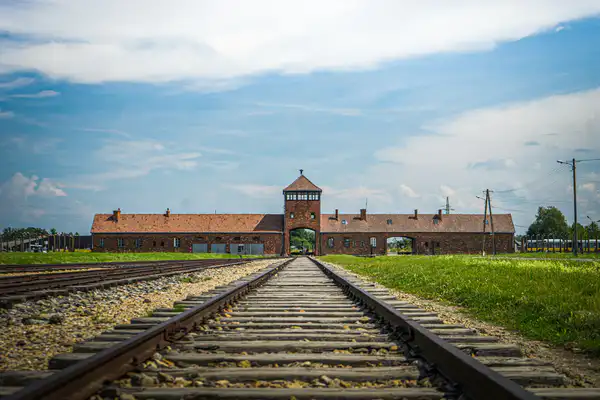
Auschwitz-Birkenau, located near the town of Oświęcim in southern Poland, is the largest and most notorious of the Nazi German concentration and extermination camps, and the site where approximately 1.1 million people — the vast majority of them Jews — were systematically murdered between 1940 and 1945. It stands today as the pre-eminent symbol of the Holocaust, a place of sacred testimony where the physical evidence of industrialized genocide has been preserved as a permanent warning to humanity. The camp complex consisted of three main sites: Auschwitz I, the original concentration camp established in 1940 in converted Polish army barracks; Auschwitz II-Birkenau, the vast extermination camp built in 1941 specifically for mass killing operations, containing four gas chambers and crematoria capable of murdering and incinerating thousands of people per day; and Auschwitz III-Monowitz, a forced labor camp serving the IG Farben synthetic rubber factory. Together with over forty sub-camps, the Auschwitz complex covered more than forty square kilometers and represented the most industrially efficient killing operation in human history. The preserved site includes the original brick and wooden barracks, the ruins of the gas chambers and crematoria (dynamited by the SS in January 1945 in an attempt to destroy evidence), guard towers, electrified barbed wire fences, the railway siding where deportation trains arrived and selections for immediate death were conducted, and the infamous gate bearing the cynical inscription "Arbeit macht frei" — Work sets you free. The museum's collections include over 100,000 pairs of shoes, 3,800 suitcases, 40 kilograms of eyeglasses, and two tons of human hair — physical remnants of the murdered, preserved behind glass in the camp's exhibition barracks. UNESCO inscribed Auschwitz-Birkenau as a World Heritage Site in 1979 under a unique criterion: as "a symbol of humanity's cruelty to fellow humans in the 20th century." The memorial receives over two million visitors annually, making it the most-visited Holocaust memorial site in the world. It exists not as a monument to the perpetrators but as a testament to the victims — a place where the sheer scale of the evidence makes denial impossible and where every visitor is confronted with the consequences of hatred, indifference, and the abandonment of moral responsibility.
Historical Significance
“Auschwitz-Birkenau represents the absolute nadir of human civilization — the point at which industrial technology, bureaucratic efficiency, and ideological hatred were combined to create a system of murder unprecedented in scale and method. It is the place where the Holocaust — the systematic, state-sponsored persecution and murder of six million Jews by the Nazi regime and its collaborators — reached its most concentrated and terrible expression. The camp's significance extends beyond the historical to the moral and philosophical. Auschwitz has become a universal symbol of evil, a reference point in ethical discourse, and a warning about the consequences of racism, antisemitism, dehumanization, and the failure of ordinary people to resist tyranny. The testimony of survivors — Primo Levi, Elie Wiesel, Tadeusz Borowski, and hundreds of others — created a body of literature and witness that has permanently altered humanity's understanding of itself. UNESCO inscribed the site in 1979 under a unique formulation, recognizing it not for its architectural or historical value in the conventional sense but as "a symbol of humanity's cruelty to fellow humans." The preservation of the physical evidence — the barracks, the ruins, the personal belongings of the murdered — ensures that future generations cannot claim ignorance of what occurred here.”
故事
4History
👑 Built by
Nazi German SS (Schutzstaffel), under the direction of Heinrich Himmler and Rudolf Höss (camp commandant)
April 1940 - SS-Hauptsturmführer Rudolf Höss establishes Auschwitz I in converted Polish army barracks
June 14, 1940 - First transport of 728 Polish political prisoners arrives
September 3, 1941 - First experimental gassing using Zyklon B kills 600 Soviet POWs and 250 sick prisoners
October 1941 - Construction of Auschwitz II-Birkenau begins; designed as extermination facility
January 1942 - Wannsee Conference formalizes the "Final Solution"; Auschwitz designated as primary killing center
March 1942-November 1944 - Mass deportations and systematic murder of Jews from across occupied Europe
May-July 1944 - 437,000 Hungarian Jews deported to Auschwitz; approximately 320,000 murdered immediately
October 7, 1944 - Sonderkommando uprising; Crematorium IV partially destroyed
January 17, 1945 - SS begins "death marches," evacuating approximately 56,000 prisoners
January 27, 1945 - Soviet Red Army liberates the camp; finds approximately 7,000 surviving prisoners
April 2, 1947 - Rudolf Höss executed at Auschwitz I, near Crematorium I
1979 - UNESCO World Heritage Site inscription