
About
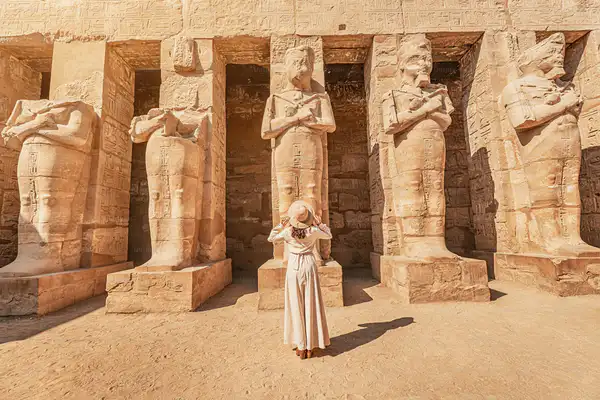
The largest religious building ever constructed, a 200-acre sacred complex built by 30+ pharaohs over 2,000 years, centered on the awe-inspiring Great Hypostyle Hall with its 134 colossal columns.
Historical Significance
“Karnak was the most important religious center in ancient Egypt for nearly two millennia, serving as the primary temple of Amun-Ra — the king of the gods and the patron deity of the Egyptian empire during the New Kingdom. The complex was known in ancient times as Ipet-isut, "The Most Select of Places," and its high priests wielded power that at times rivaled the pharaoh himself. The temple's significance extended far beyond religion. Karnak was the economic engine of ancient Thebes, controlling vast agricultural estates, trading networks, and a workforce numbering in the tens of thousands. The Opet Festival, an annual celebration in which the statue of Amun was carried from Karnak to Luxor Temple along a 2.7-kilometer avenue of sphinxes, was the most important religious event in the Egyptian calendar, reinforcing the pharaoh's divine mandate and the cosmic order of the state. Each pharaoh who contributed to Karnak was motivated by both devotion and politics. Building at Karnak demonstrated piety to Amun and cemented the pharaoh's legitimacy. The result was a complex where architectural styles spanning two thousand years coexist in extraordinary juxtaposition — Middle Kingdom foundations beneath New Kingdom colossi, Ptolemaic gates beside pharaonic obelisks, Roman additions alongside structures contemporary with the Biblical patriarchs. The complex was inscribed as a UNESCO World Heritage Site in 1979 as part of Ancient Thebes with its Necropolis, recognized as one of the most significant concentrations of religious architecture in human history.”
이야기
4History
👑 Built by
Multiple pharaohs: Senusret I, Hatshepsut, Thutmose III, Amenhotep III, Seti I, Ramesses II, and many others
c. 2000 BC - Senusret I builds the earliest known structures at the site
c. 1479 BC - Hatshepsut erects the tallest obelisks (29.5 meters) at Karnak
c. 1457 BC - Thutmose III records the Battle of Megiddo on the temple walls
c. 1390 BC - Amenhotep III builds the Third Pylon and expands the precinct
c. 1279 BC - Seti I begins the Great Hypostyle Hall; Ramesses II completes it
c. 332 BC - Alexander the Great visits and repairs the sanctuary
c. 300-30 BC - Ptolemaic rulers add gates and decorative elements
1798 - Napoleon's scholars produce comprehensive documentation
1844 - Karl Richard Lepsius conducts systematic archaeological survey
1895 - Georges Legrain begins long-term excavation and restoration program
1979 - UNESCO World Heritage Site inscription (Ancient Thebes with its Necropolis)
2021 - Avenue of Sphinxes between Karnak and Luxor Temple restored and reopened