
About
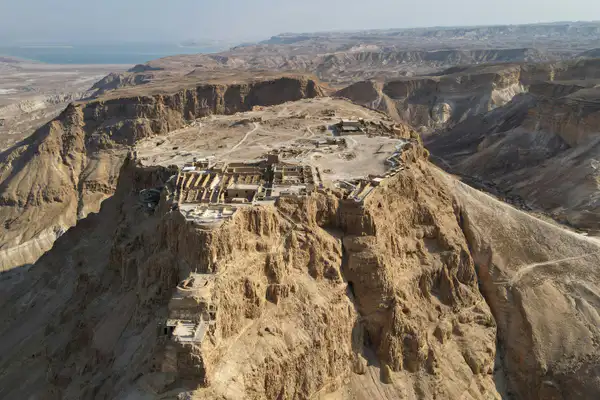
Masada is an ancient fortress perched atop an isolated rock plateau on the eastern edge of the Judaean Desert, overlooking the Dead Sea from a height of approximately 450 meters above its surface. The name derives from the Hebrew word metzuda (מצודה), meaning "fortress" or "stronghold," and no site in Israel more perfectly embodies that meaning. Rising as a sheer-walled mesa with diamond-shaped summit measuring roughly 600 meters north to south and 300 meters east to west, Masada is a natural citadel made nearly impregnable by cliffs that drop between 300 and 400 meters on all sides — a geological formation so dramatic that Herod the Great chose it as the site of his most spectacular fortress-palace. Between approximately 37 and 31 BC, Herod transformed this desolate summit into an astonishing complex of palatial residences, fortifications, storehouses, and an ingenious water system that defied the surrounding desert. The most breathtaking structure was the three-tiered Northern Palace, an architectural masterpiece that cascaded down the sheer northern cliff face across three natural rock terraces. The upper terrace contained Herod's private living quarters with a semicircular balcony offering panoramic views of the Dead Sea and the mountains of Moab beyond. The middle terrace, approximately 20 meters below, featured a circular pavilion with Corinthian columns used as a relaxation hall. The lowest terrace, another 15 meters down, held a lavish bathhouse and banquet hall with frescoed walls in the Roman Second Style, featuring painted columns, panels, and geometric designs that rivaled anything in Rome itself. Herod's engineers carved an elaborate system of twelve enormous cisterns into the northwestern cliff face, capable of holding a total of approximately 40,000 cubic meters of water — enough to sustain a garrison of thousands through extended sieges. An aqueduct system channeled flash-flood waters from two nearby wadis (Wadi Masada and Wadi Ben Yair) into these cisterns, while workers and donkeys carried water up the winding Snake Path to rooftop pools in the palace complex. The Western Palace — the largest structure on the summit at approximately 4,000 square meters — served as the ceremonial and administrative center, featuring elaborate mosaic floors, a throne room, and private apartments. Additional structures included a synagogue (one of the oldest ever discovered), a columbarium, elaborate Roman-style bathhouses with a hypocaust heating system, and massive storerooms that could hold provisions for years. But Masada's fame rests not on Herod's architectural genius alone. It was here, in 73 or 74 CE, during the final chapter of the Great Jewish Revolt against Rome, that 960 Jewish men, women, and children — the last holdouts of the rebellion — chose death over enslavement. After the fall of Jerusalem and the destruction of the Second Temple in 70 CE, a group of Jewish rebels known as the Sicarii, led by Eleazar ben Ya'ir, seized Masada and held it as a final refuge. For nearly three years they lived atop the mountain, using Herod's storehouses and water system to survive. When the Roman governor Flavius Silva finally marched the Tenth Legion (Legio X Fretensis) and thousands of Jewish slave laborers to the base of Masada, he constructed an enormous siege ramp against the western face — a ramp of earth and stone still visible today, rising approximately 100 meters from the desert floor. According to the Jewish-Roman historian Flavius Josephus, when the Romans breached the walls and were poised to enter, Eleazar persuaded his followers to destroy their possessions and take their own lives rather than become Roman slaves. Ten men were chosen by lot to carry out the deed, then one was chosen to kill the remaining nine before falling on his own sword. When the Romans entered the next morning, they found 960 bodies and a fortress in flames — with food stores left deliberately intact to show that the defenders had chosen death, not been starved into submission. Archaeologist Yigael Yadin's landmark excavations of 1963-1965, utilizing thousands of volunteers from around the world, dramatically confirmed many aspects of Josephus's account. Among the most evocative discoveries were eleven small pottery shards (ostraca) inscribed with names — including one reading "Ben Ya'ir" — which Yadin identified as the possible lots used by the last defenders to select the ten executioners. The discovery electrified the world and cemented Masada as the supreme symbol of Jewish courage and the refusal to submit to oppression. The phrase "Masada shall not fall again" became a foundational oath of modern Israel, and for decades Israeli Defense Forces soldiers took their swearing-in oath atop the fortress. UNESCO inscribed Masada as a World Heritage Site in 2001, recognizing it as "a symbol of the ancient Kingdom of Israel, its violent destruction, and the last stand of Jewish patriots in the face of the Roman army."
Historical Significance
“Masada occupies a singular place in the history of ancient Israel and in the collective memory of the Jewish people. Its significance operates on multiple levels — as a supreme example of Herodian architecture and engineering, as the site of the last stand of the Great Jewish Revolt, and as the most powerful symbol of Jewish national identity in the modern era. Herod the Great's transformation of Masada between 37 and 31 BC represents one of the most ambitious building projects of the ancient Near East. Threatened by both the Hasmonean dynasty he had displaced and by Cleopatra VII of Egypt, who coveted Judaea, Herod chose Masada as his ultimate refuge — a place where he could withstand any siege indefinitely. The Northern Palace, cascading down three cliff terraces with Corinthian columns, frescoed walls, and private bathhouses, demonstrated that even in a desert wilderness, Herod intended to live in the style of a Roman patrician. The water system, capable of storing 40,000 cubic meters harvested from flash floods, was an engineering triumph that turned an arid mountaintop into a self-sustaining paradise with swimming pools and irrigated gardens. The Great Jewish Revolt of 66-73 CE was the most devastating military conflict between Rome and Judaea. After the destruction of Jerusalem and the Second Temple by Titus in 70 CE — a catastrophe from which Judaism had to reinvent itself entirely — Masada became the final ember of armed resistance. The Roman siege of Masada was itself an extraordinary military operation: Flavius Silva constructed eight military camps around the base (their outlines still perfectly visible from the summit), a circumvallation wall of approximately 4,500 meters encircling the entire mountain, and the massive assault ramp on the western slope — one of the most remarkable surviving examples of Roman siege engineering anywhere in the world. The mass suicide — if it occurred as Josephus described — has been the subject of intense scholarly debate. Some historians question whether Josephus, who was not present and who served as a Roman propagandist, may have embellished or invented details. The discovery of 28 skeletons in a cave below the southern cliff during Yadin's excavation, along with the famous ostraca, provided physical evidence supporting some aspects of the account, though the interpretation remains contested. Whether the final act was mass suicide, a last battle, or something in between, the archaeological evidence confirms that Masada's defenders resisted Rome to the very end. In the 20th century, Masada was elevated to the central myth of modern Zionism. The archaeologist Shmaria Guttman organized youth pilgrimages to the site in the 1940s, and after Israeli independence in 1948, the phrase "Masada shall not fall again" (מצדה לא תיפול שנית) became an unofficial national motto. Israeli Defense Forces soldiers took their oath of allegiance atop Masada for decades. UNESCO inscribed the site in 2001, recognizing both its archaeological importance and its profound symbolic resonance as a place where the choice between freedom and subjugation was made in the most absolute terms imaginable.”
Stories
5History
👑 Built by
Herod the Great (37-31 BC); earlier fortifications attributed to the Hasmonean dynasty (c. 140-37 BC)
c. 140-37 BC - Hasmonean dynasty establishes initial fortifications atop the Masada plateau
37-31 BC - Herod the Great constructs the fortress-palace complex including the Northern Palace, Western Palace, storehouses, bathhouses, and water system
4 BC - Death of Herod; Roman garrison occupies Masada
66 CE - Jewish Sicarii rebels, led by Menahem ben Judah, capture Masada from the Roman garrison at the outbreak of the Great Revolt
70 CE - Fall of Jerusalem and destruction of the Second Temple; additional refugees flee to Masada
72-73 CE - Roman governor Flavius Silva besieges Masada with Legio X Fretensis and auxiliary forces, constructing eight camps, a circumvallation wall, and a massive siege ramp
73 CE (April 16) - Romans breach the wall; 960 defenders perish in mass suicide according to Josephus's account
5th-6th century CE - Byzantine monks establish a small church and hermitage on the summit
1838 - American scholars Edward Robinson and Eli Smith identify the site as the ancient Masada described by Josephus
1963-1965 - Yigael Yadin conducts landmark excavations with thousands of international volunteers, uncovering Herod's palaces, the synagogue, and the famous ostraca lots
1971 - Cable car system installed, making the summit accessible to all visitors
2001 - UNESCO inscribes Masada as a World Heritage Site, recognizing its archaeological and symbolic significance