
About
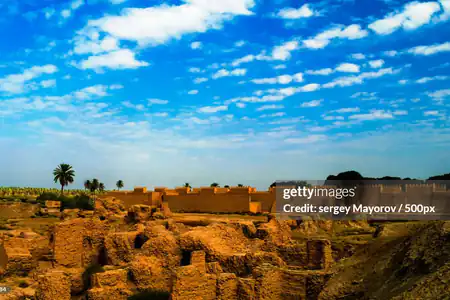
Babylon — the very name conjures visions of towering ziggurats, lush hanging gardens, and the hubris of empires that dared to build a stairway to heaven. Located on the flat alluvial plains of Mesopotamia, roughly 85 kilometers south of modern Baghdad near the city of Hillah, Babylon was for centuries the largest and most magnificent city on Earth. Its name derives from the Akkadian Bab-ilani, meaning "Gate of the Gods," and the city lived up to that title: it was the political, religious, and intellectual capital of multiple empires, the birthplace of astronomy, mathematics, and codified law, and the setting for some of the most enduring stories in human civilization — from the Tower of Babel to the writing on the wall at Belshazzar's feast. Babylon reached its zenith under Nebuchadnezzar II (reigned 605-562 BC), the Neo-Babylonian king who transformed it into a wonder of the ancient world. He rebuilt the city on a scale that staggered contemporaries: massive double walls stretching over 18 kilometers in circumference (wide enough, Herodotus claimed, for two four-horse chariots to pass each other on top), the dazzling Ishtar Gate sheathed in glazed blue bricks and adorned with 575 golden dragons and bulls, and the great Processional Way — a 250-meter ceremonial avenue lined with 120 roaring lions in glazed relief through which the statue of Marduk was paraded during the New Year festival. At the city's heart rose the Etemenanki, the great ziggurat dedicated to Marduk that may have inspired the biblical Tower of Babel — a colossal stepped pyramid that ancient sources claim reached 91 meters in height, visible for miles across the flat Mesopotamian plain. The Hanging Gardens, attributed to Nebuchadnezzar by later Greek and Roman writers, were counted among the Seven Wonders of the Ancient World — yet no Babylonian text mentions them, and no archaeological trace has been found at the site. This absence has fueled one of archaeology's greatest debates. Oxford Assyriologist Stephanie Dalley has provocatively argued that the Hanging Gardens were actually built by the Assyrian king Sennacherib at Nineveh, not Babylon, and that later Greek writers confused the two cities. Others maintain they existed at Babylon but were destroyed before they could be recorded. The romantic legend persists: that Nebuchadnezzar built the terraced paradise for his Median wife Amytis, who was homesick for the green mountains of her homeland — an engineering marvel of elevated terraces, hydraulic irrigation, and exotic plantings that created an artificial mountain of greenery in the desert. Babylon's final great chapter was written by Alexander the Great, who conquered the city in 331 BC and was so captivated that he declared it the capital of his world empire. He planned vast restorations and a monumental harbor, but the city became his tomb instead: on June 10 or 11, 323 BC, Alexander died in the palace of Nebuchadnezzar at the age of 32, after a mysterious illness following days of heavy drinking. Whether he was poisoned, succumbed to typhoid fever, or was killed by some other cause remains hotly debated. His death in Babylon shattered the largest empire the world had ever seen and plunged the ancient world into decades of warfare among his successors. Today, the ruins of Babylon — inscribed as a UNESCO World Heritage Site in 2019 after years of campaigning — spread across a vast area of crumbling mud-brick walls, foundations, and reconstructed gateways, a humbling reminder that even the mightiest cities are mortal.
Historical Significance
“Babylon was arguably the most influential city in the ancient Near East, and its impact on human civilization is almost impossible to overstate. It was here, under Hammurabi in the 18th century BC, that one of the world's earliest and most comprehensive legal codes was promulgated — the Code of Hammurabi, a 2.25-meter black diorite stele inscribed with 282 laws that established principles of justice, contract law, and proportional punishment that echo through legal systems to this day. Babylonian astronomers mapped the heavens with astonishing precision, developed the sexagesimal (base-60) number system that still gives us our 60-minute hours and 360-degree circles, and compiled astronomical observations spanning centuries that formed the foundation of both Greek and later Islamic astronomy. Under Nebuchadnezzar II, Babylon became the largest city in the world, with a population estimated between 200,000 and 300,000. His conquest of Jerusalem in 586 BC and the subsequent Babylonian Captivity of the Jewish people became one of the defining events in biblical history, profoundly shaping Jewish theology, identity, and the composition of the Hebrew Bible. The exile produced some of the most powerful literature in the Old Testament — the Psalms of lament ("By the rivers of Babylon, we sat down and wept"), the apocalyptic visions of Daniel, and the prophetic writings of Ezekiel and Jeremiah. Babylon itself became a biblical byword for worldly corruption, excess, and divine judgment — an image that persists from the Book of Revelation to modern popular culture. The city's later history was equally dramatic. After Cyrus the Great of Persia conquered Babylon peacefully in 539 BC, it remained a major center of learning and commerce under successive Persian, Macedonian, and Seleucid rulers. Alexander the Great's death here in 323 BC is one of the most consequential events in world history, triggering the Wars of the Diadochi that carved the Hellenistic world into rival kingdoms. The original Ishtar Gate and Processional Way, excavated by German archaeologist Robert Koldewey between 1899 and 1917, were transported to Berlin, where the reconstructed gate stands today in the Pergamon Museum — one of the most visited ancient artifacts in the world. Babylon's inscription as a UNESCO World Heritage Site in 2019 represented a hard-won victory after decades of damage from Saddam Hussein's ill-conceived reconstruction projects and the impact of the Iraq War, during which a US military base was controversially built on part of the ancient site.”
داستانها
6History
👑 Built by
Akkadian and Amorite rulers (earliest), Hammurabi (1792-1750 BC), Nebuchadnezzar II (605-562 BC, greatest builder)
~2300 BC - Earliest known references to Babylon as a small Akkadian town
1894 BC - Amorite dynasty establishes the First Babylonian Empire (Old Babylonian period)
1792-1750 BC - Hammurabi reigns; issues the Code of Hammurabi; Babylon becomes regional capital
1595 BC - Hittites sack Babylon; Kassite dynasty takes control for four centuries
689 BC - Assyrian king Sennacherib destroys Babylon in retaliation for rebellion
626 BC - Nabopolassar founds the Neo-Babylonian (Chaldean) Empire; Babylon reborn
605-562 BC - Nebuchadnezzar II rebuilds Babylon as the greatest city in the world: Ishtar Gate, Etemenanki ziggurat, Processional Way, massive walls
586 BC - Nebuchadnezzar destroys Jerusalem and deports Jews to Babylon (Babylonian Captivity)
539 BC - Cyrus the Great of Persia conquers Babylon peacefully; frees the Jewish captives
331 BC - Alexander the Great conquers Babylon and declares it his imperial capital
323 BC - Alexander the Great dies in the Palace of Nebuchadnezzar at age 32
275 BC - Seleucids found nearby Seleucia; Babylon's population declines over centuries
1899-1917 - Robert Koldewey excavates the Ishtar Gate, Processional Way, and city foundations
1983-2003 - Saddam Hussein controversially rebuilds parts of Babylon with inscribed bricks bearing his name
2019 - Inscribed as UNESCO World Heritage Site